The outage wasn't yours. The downtime doesn't have to be.
Prevention and fast response stop at the boundary of what you own. Autonomous operations carry uptime across it when a provider you can't fix fails.

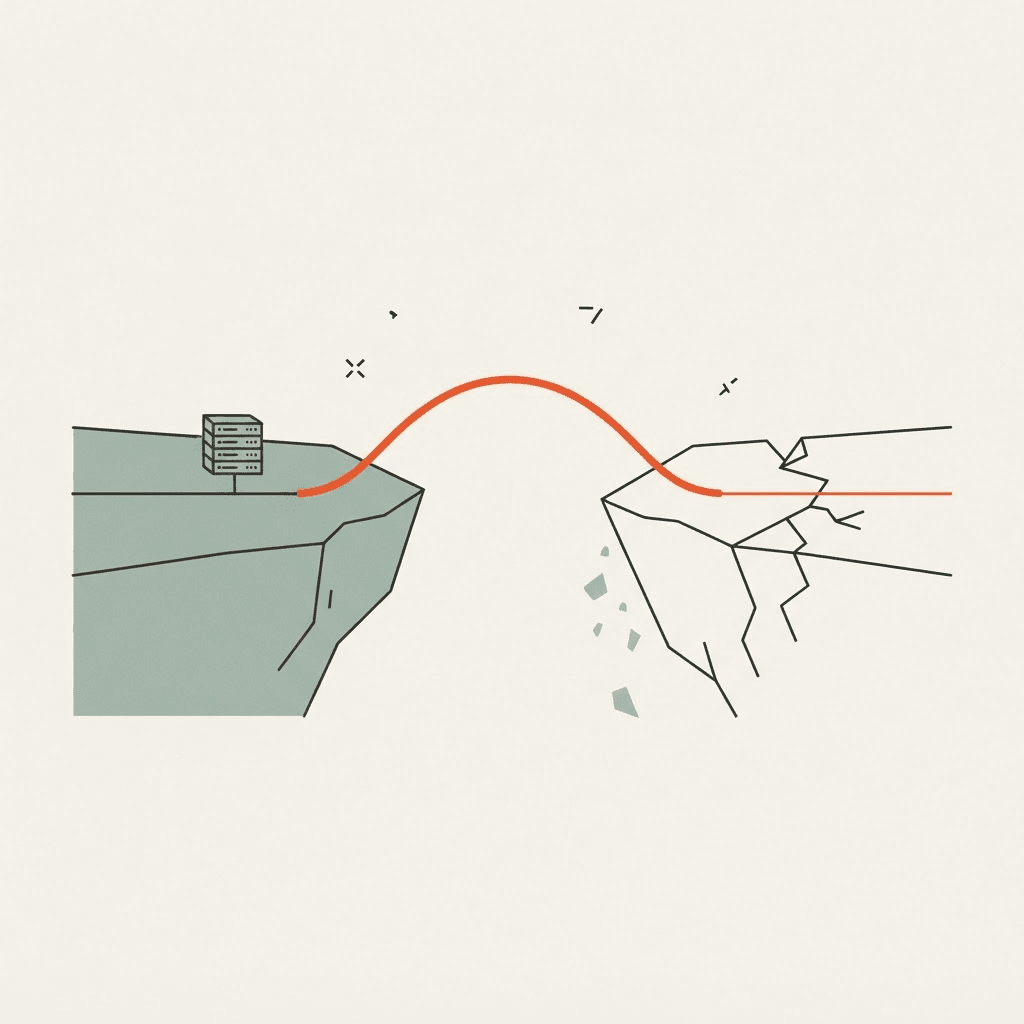
AUTONOMOUS OPERATIONS
Prevention and fast response matter. They end at the boundary of what you own. Autonomous operation carries uptime across it.
The argument, up front. Preventing failures and responding fast are essential, and a Production Ops Agent should do both: fix the underlying issue before a threshold trips, resolve what breaks in minutes. But both were built for systems you own, and more of your production now runs on systems you don't: hyperscaler services and packaged software you can't see into or change. When the fault sits on the far side of that boundary, prevention can't reach it and a manual response can only absorb it.
What remains is the resilience you own outright: the ability to operate through the failure. Detect from the outside, execute your continuity policy, fail over apps and data, hold uptime. That capability, autonomous operation, is the subject of this piece. It completes prevention and response; it doesn't replace them.
THE DEFINITION
What autonomous operations means for borrowed resilience
Autonomous operations is the capability to operate through a failure you cannot fix. It detects the failure from the outside, executes your continuity policy, fails over the affected apps and their data, and holds uptime while a provider or vendor works the problem on its own clock. Prevention and fast response act on systems you can inspect and change. Autonomous operations covers the failures on the far side of that boundary, where your instrumentation stops and the fix path runs through the vendor's support queue. A Production Ops Agent runs three layers: Prevent, Respond, and Operate. This is the Operate layer. It carries uptime across the boundary while the vendor fixes its own bug.
THE NEWS
The provider's own resilience is a box you can't see into
This month a Google Cloud region went dark for roughly fifteen hours, taking VMware Engine, NetApp Volumes, and Bare Metal Solutions with it, all from a power and cooling failure at a single facility. The uncomfortable part was not that a data center lost power. It was how hard it remains to know what a hyperscaler's resilience will actually do in the moment. It is the pattern of the year: uninterruptible power supplies that did not switch on, stretched clusters built to fail over automatically that did not. Forrester expects more multi-day hyperscaler outages, not fewer. The resilience you are counting on is real, but it lives inside a box you can't inspect, and it doesn't always fire.
Reference: The Register, 21 July 2026; Forrester Predictions 2026: Cloud Computing.
THE REAL PROBLEM
Even done well, prevention ends where ownership ends
Reactive and preventive operations are the right instincts, and worth every ounce of investment they get. They share one assumption the boundary breaks: that you can see and change the thing that fails. Prevention hardens everything you control, then an upstream fault takes you down anyway. Response pages your people while a provider you can't reach works the problem on its own clock. Your resilience, increasingly, is borrowed. You have rented it from providers and vendors whose terms you can't read, and a hyperscaler outage is what it looks like when those terms turn out to be opaque and unreliable at the same time.
And this is not a once-a-year cloud event. The everyday version sits in your own data center. Most enterprises run a large share of production on packaged and COTS systems: closed binaries with a vendor's canned telemetry, no way to add your own instrumentation, and a fix path that routes through a support ticket instead of your runbook. Correlation and root-cause analysis stall at exactly these components, because the tools that would explain them assume you instrumented them. You did not, and you cannot.
78% of teams had an incident where no alert fired and a customer noticed first (2026 State of Production Reliability and AI Adoption Report). That is a black box failing quietly, and it is the norm, not the edge case. The share of your outage risk that lives behind a boundary you don't own is going up, not down.
The only resilience you truly own is your ability to operate around the boundary.
THREE LAYERS, ONE CEILING
Each layer does its job, up to the boundary
PREVENT, stop what you can. NeuBird fixes the underlying issue before a threshold trips and catches degradation early. It holds until the fault is upstream, inside a box your hardening can't reach.
RESPOND, resolve what breaks. When something breaks, NeuBird resolves it autonomously, in minutes. When the break sits inside a provider you can't touch, resolving it means routing around the dependency and holding uptime while the provider works its own fix.
OPERATE, carry uptime across. The layer the boundary demands: detect from the outside, fail over apps and data, hold uptime while the provider works on its own clock. It turns "we can't fix it" into "we stayed up."
The shortcuts don't clear the boundary. A reactive agent bolted onto your alert queue answers pages faster, but the incidents that hurt here never fired an alert; DIY on noise is still noise. Single-cloud provider agents see only their own cloud, so they go blind across your COTS systems, your on-prem estate, and everything cross-vendor, which is most of where this risk lives.
WHAT COMES NEXT
Operate through the failure, autonomously
NeuBird's Production Ops Agent keeps you running while the vendor's bug is still open. It detects the failure from the outside, from the symptoms your own systems show. It localizes fast: the Prod Ops Agent actively probes the dependency, queries its health endpoints, and triangulates that live state against your topology and the behavior your services are exhibiting. Then it executes your continuity policy: reroute, fail over the affected apps and their data, degrade gracefully, and hold uptime while the provider does whatever it does behind its boundary. When something does break, root-cause analysis lands in under five minutes at 94% accuracy, with the causal chain shown step by step.
This is also how prevention and response cross the boundary. The same outside-in detection and health probing catch degradation your instrumented tools can't see, and correlate symptoms across a dependency that will never hand you a trace. In a black-box world you don't retreat from prevention and fast response. You extend them, and add the ability to operate through what neither can stop.
Detect outside-in, localize by probing health and topology, decide with your continuity policy, act by failing over apps and data, hold uptime, and learn. The loop runs without waiting on you or the vendor.
The reframe that matters: you cannot root-cause the inside of a black box, but you can pinpoint its role in your failure from the outside, and you can operate around it. That is the whole distance between knowing what broke and staying up anyway.
GUARDRAILS
Autonomous, with a human in the loop by design
NeuBird stages every remediation and cannot change your systems without explicit human approval. It works on a policy spectrum of Suggest, Recommend, and Act, and a human approves every action at each level. Every action is logged with a full audit trail for regulated environments. It reasons over live context inside your own environment and is SOC 2 Type II certified. You decide how much autonomy to grant, and the platform earns more as it proves itself on your estate.
WHAT IT PROTECTS
Uptime you can put in a contract
A recovery-time objective that depends on a human executing a failover at 3am is a number you hope for, not one you can commit to. Autonomous operation closes that gap, because the policy runs itself the moment a dependency degrades. The downstream math follows: a 60% or greater reduction in incident cost, and a single agent running production across cloud, on-prem, VPC, hybrid, and air-gapped environments at roughly a tenth of the cost of the stack it replaces.
Reliability stops being something you manage around and becomes something you can guarantee.
WHERE TO START
Two questions for Monday morning
First, take your most critical dependencies, the hyperscaler services and the packaged systems you can't see into, and ask a blunt question of each: can we detect its failure and fail over without the vendor's help? Everywhere the answer is no, that is resilience debt, and it is already on your books.
Second, as you buy the next system, make agent-ready health and diagnostic surfaces a requirement, not a nice-to-have. The bar is rising across the industry, and the estates that demand it will be the easiest to keep running when a dependency goes dark.
You cannot prevent the outage you don't own. You can decide, now, whether the downtime is yours too.
See it operate through a failure, in your environment. Bring a dependency you can't see into. We'll show you detection, localization, and failover on your own topology.