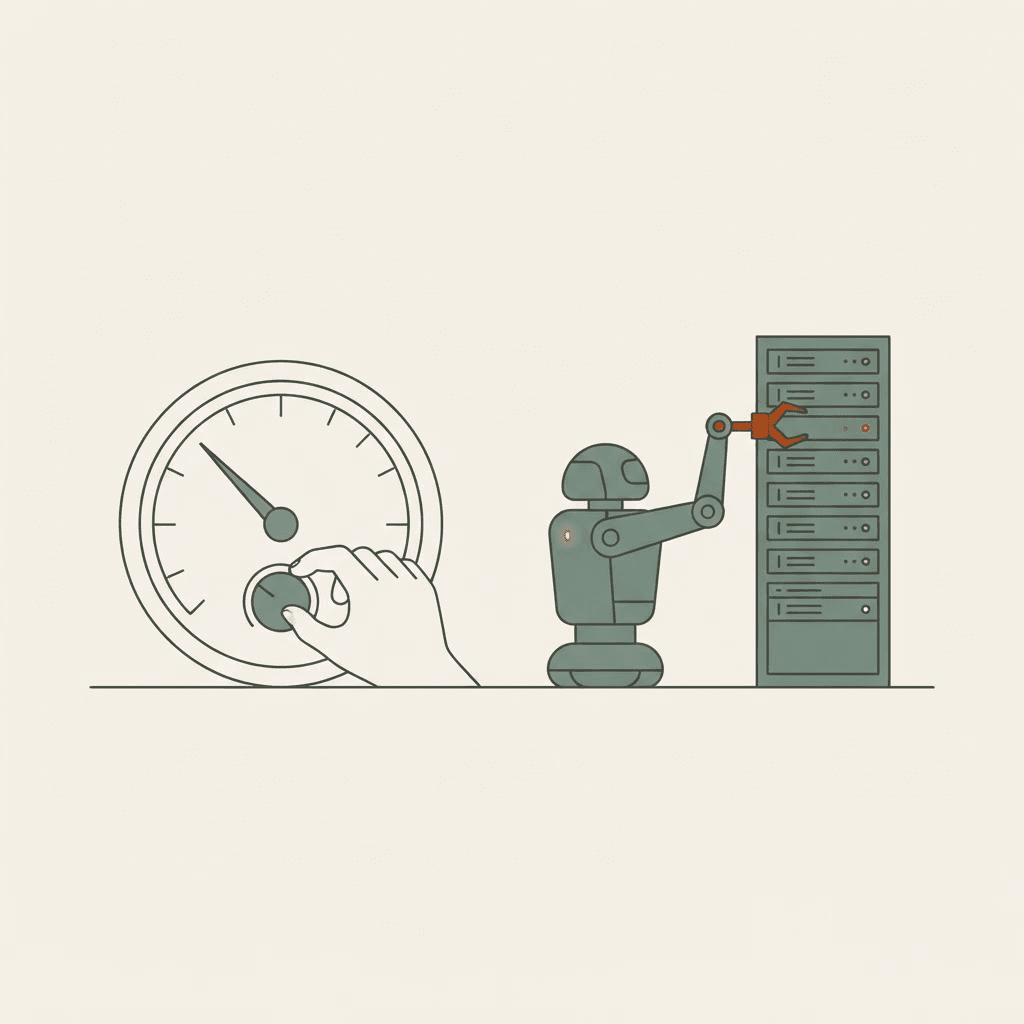
The True Cost of Ungoverned Operations Agents
Engineering teams are defending ballooning AI bills while still losing 40% of their time to war rooms. It’s time to move from noisy scripts to an accountable Prod Ops Agent.

Right now, engineering and finance leaders are sitting down for 2027 budget planning. Across calendars and spreadsheets, a new line item has appeared that was not there two years ago: model and agent spend.
For the past eighteen months, almost every engineering leadership team made the exact same bet. Production environments had outgrown human scale, alerts were overwhelming on-call rotations, and systems had become too complex for manual triaging. The logic felt obvious: point AI at operations and watch the operational pain go away.
That bet made sense. But as leadership teams defend their spend this quarter, most executives are holding two documents that simply do not reconcile.
The first is a monthly AI token invoice, precise right down to the penny.
The second is an operational accomplishments list that does not align to the spend.
The Accounting Paradox
On the invoice, everything is quantified. You see prompt tokens, completion tokens, dedicated inference instances, and API charges cleanly itemized by vendor and workspace. Finance can track every single dollar spent.
Look at the second document, the accomplishments list, however, and the clarity evaporates. Alert fatigue never broke. Outages still pull eight senior engineers into cross-functional war rooms. Mean time to resolution has barely budged. And at 2 AM, your on-call engineer is still the correlation engine of last resort, clicking across four or five separate dashboards to manually piece together an alert storm.
Industry studies show that up to 40% of engineering time is still lost to incident firefighting and maintenance toil. How can spend be so mathematically exact while the return remains completely intangible?
The problem is not that the underlying intelligence failed. Large language models are remarkably capable, and intelligence has become abundant.
The failure lies in how the broader market attempted to shortcut operational architecture.
Why the "AI SRE" Narrative Hit a Wall
Early on, the industry rushed behind a simplistic premise: building an "AI SRE".
That framing quickly hit a wall across two fronts:
- Misaligned Ownership: Labeling everything an SRE tool routed adoption directly to teams that rarely hold the mandate or budget to transform end-to-end production operations.
- The DIY Illusion: Positioning AI as a drop-in human replacement convinced engineering buyers they could easily stitch together their own internal scripts, runbook bots, or basic LLM wrappers.
What followed was an explosion of disjointed point tools. A platform team deployed an incident summarizer. An operations group hooked a prototype script to an alert queue. Monitoring vendors slapped copilot buttons across their existing UIs.
Instead of operational maturity, enterprises introduced an ungoverned operational blind spot. When you inspect what that invoice actually paid for, three hidden operational taxes emerge:
- Uncurated Data Dumps: Ad-hoc tools lack structured, governed access to systems, forcing teams to dump gigabytes of raw logs and telemetry noise into prompts at premium frontier-model prices.
- Amnesiac Systems: Standalone scripts possess zero institutional memory. When a failure pattern recurs, the tool starts from scratch, billing you for the exact same reasoning pass all over again.
- Fragmented Access: Uncoordinated bots demand scattered API keys and disjointed permissions. No one can audit which script touched production, what data it ingested, or who authorized its actions.
Wiring an LLM to an API is easy. Operating safely and reliably inside a living production environment is fundamentally different. Pointed at raw alert queues with no structural context, smart models just chase noise faster.
Doubling Down on the Production Operations Agent
For months now, we have been having this exact conversation with engineering leaders: production is not a playground for disposable scripts or generic bots.
We have continually advocated for a distinct, dedicated category: The Production Operations Agent (Prod Ops Agent).
A true Prod Ops Agent isn't a conversational novelty. It is built around three non-negotiable operational responsibilities:
- Prevent: Surfacing subtle system anomalies and degradation upstream before user-facing alerts cascade into an outage.
- Resolve: Querying across 15+ telemetry sources in parallel to isolate root cause in under five minutes with verifiable, cited evidence—never hallucinations.
- Operate: Staging deterministic remediations and coordinating day-to-day operational workflows directly alongside human teams.
Leverage, Not Replacement
The conversation around operations AI was muddied by two years of reckless messaging promising autonomous headcount replacement.
Telling engineering organizations that an autonomous script will replace their engineers was always insulting to practitioners and technically reckless in mission-critical environments. Production systems are living, dynamic architectures that demand human intuition, architectural accountability, and verified judgment.
The mandate has always been leverage.
Real leverage means automating the 2 AM multi-tool archaeology, not the engineer. It means the Prod Ops Agent executes the heavy lifting, tracing the causal graph across complex distributed systems while your engineers stay on the gate to evaluate findings and authorize staged remediations.
When systems are built around leverage, the economic outcome is tangible: returning up to 40% of engineering capacity back to shipping products while cutting incident management costs by over 60%.
What Leaders Must Demand for 2027
If your team is defending an AI budget this planning cycle, stop funding uncurated token waste and unmanaged scripts.
Before renewing model subscriptions or expanding fragmented agent pilots, demand that every agentic interaction produces a Verified Operational Receipt:
- What Degraded: A precise, system-level diagnosis caught upstream.
- The Cited Evidence: A traceable causal chain derived directly from live telemetry.
- The Cost Avoided: Quantifiable impact demonstrating avoided downtime, eliminated war rooms, or prevented duplicate queries.
- The Named Approver: An immutable audit record showing which human engineer verified and authorized the change.
When you demand verified operational receipts, your model spend ceases to be an unexplainable IT expense. The operational accomplishments list finally reconciles with the invoice.
Production is an active, unforgiving place. It cannot be run on raw prompts and fragmented tools. It requires a Production Operations Agent built for accountability, precision, and enterprise scale.
Next week, we will share what we have built to make that standard possible.