Earned Autonomy: What It Takes for an AI Agent to Touch Production
Workday CTO Gabe Monroy and NeuBird AI's Vinod Jayaraman debate what AI agents must prove before they earn the right to act in production.

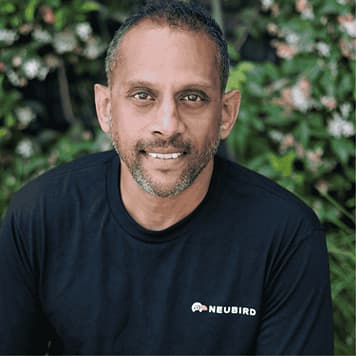
Coding agents earned trust fast. Production operations hasn't caught up, and the gap is starting to show. In this episode of the NeuBird AI podcast, Vinod Jayaraman (co-founder & CTO, NeuBird AI) and Gabe Monroy (CTO, Workday) debate "earned autonomy," the idea that an AI agent needs a ladder of trust in production just as rigorous as the one we build for human engineers.
Watch the full conversation above. Here's a quick preview of what they cover.
What has to be true before an agent gets write access to production?
Gabe's answer isn't a feature checklist, it's a sequencing problem: how do you build enough confidence, step by step, that a change is safe before it ever touches a live system that can't easily be undone. Vinod frames the same problem in terms of blast radius, narrowing the box an agent operates in until the risk of a mistake is small enough to tolerate, then widening that box as trust is earned. NeuBird AI's own marketing website, built and maintained largely by non-engineers with coding agents and monitored end-to-end, is the live example they use to ground the discussion.
Why a 1%-of-the-time bug shows the limits of today's agents
Gabe walks through a real Workday incident: a WebSocket bug that only manifested about 1% of the time, slowly leaked memory, and took four hours of skilled engineers to trace back to a cascading JVM failure. Both agree this is exactly the kind of needle-in-a-haystack, cross-system correlation where agents could shine, and exactly the kind of case where he isn't yet convinced today's agents are ready to drive.
Why coding scaled and operations hasn't, yet
Code generation took off in part because it's a verifiable domain: linters, compilers, and tests give a model a clear signal of right or wrong, which is what techniques like reinforcement learning from code execution feedback depend on. Production operations doesn't have that same generalizable feedback loop; every environment's Kubernetes setup, database tier, and traffic pattern is different. That's the gap Vinod and Gabe see closing slowly, through customer-specific data and tightly scoped autonomous actions, rather than all at once.
The first privilege agents should earn
Both land on the same answer: autonomous rollback. If an agent can prove with confidence that a specific change caused an incident, undoing that change is a well-scoped, reversible action, a much easier bar to clear than open-ended creative problem solving in a live system.
They also dig into why human-in-the-loop approval is often an accountability mechanism rather than a real safety check, what Gabe's team tracks instead (mean time to detection over mean time to recovery), and where the "devil's advocate" agent that Vinod's team built earns its keep by refusing to just agree with you.
Watch the full episode above for the entire conversation. If you're building toward autonomous production operations at your own company, see how NeuBird AI's Production Ops Agent approaches earned autonomy in practice, or book a demo to see it on your own environment.