Vibe Ops: Why AI Improvisation Fails in Production
Vibe Ops brings vibe coding's improvisation to production ops. See why that inflates cost, risk, and hallucinations, and what actually works instead.

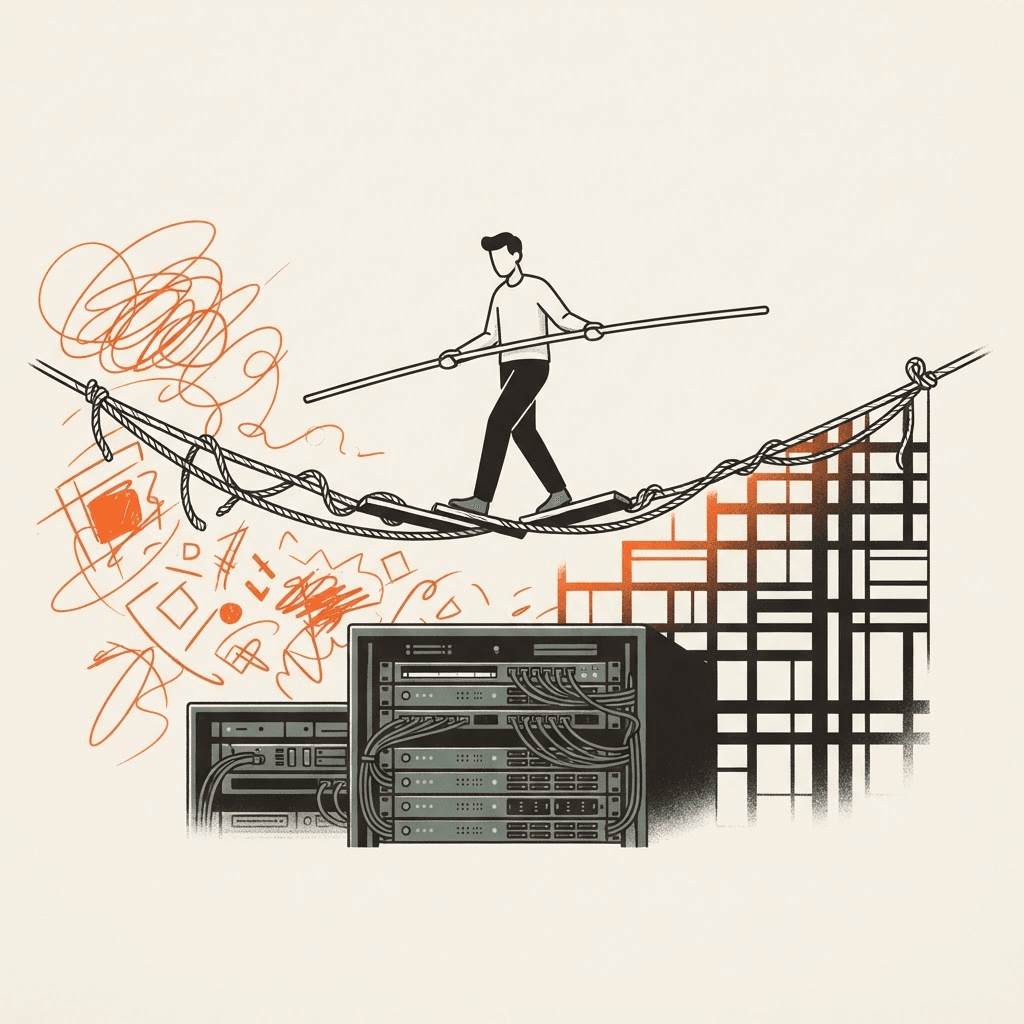
Vibe Ops? More like Vibe Ooops.
Vibe coding works in an IDE. Carried into production operations, the same habit becomes risky the moment it touches a live incident. Production removes the three conditions that keep vibe coding safe: cheap verification, cheap reversibility, and bounded context.
What is vibe ops?
Vibe ops is vibe coding applied to live production operations. An engineer pastes logs from an active incident into a chat window, asks what went wrong, and acts on the answer with the confidence the IDE taught them to have. The same pattern reaches into root cause analysis and remediation, where an unverified answer changes a running system. The practice is already common across engineering teams, which is why it now has a name: Gartner uses the term for exactly this pattern. A reliable answer in that setting depends on context construction, turning raw telemetry into the signal worth reasoning over. The paste-and-ask loop skips that step.
Why does vibe coding work but vibe ops fail?
Vibe coding works, and is even fun, because the coding environment quietly hands you three gifts. Verification is cheap: it compiles or it doesn't, tests pass or they fail, and an oracle tells you the moment you're wrong. Reversibility is cheap: git revert, delete the branch, start over. And context is bounded: the repo, the file, the stack trace, almost everything in front of the model is on-topic.
Production inverts all three, and that inversion is the whole story.
Verification becomes expensive or impossible. Root cause is sometimes genuinely intractable, because there is no "compile" for a hypothesis about why latency spiked across three services at 2 a.m. Reversibility disappears: you cannot un-drop a table, un-send a page, or un-cascade a retry storm. And context explodes into noise, petabytes of telemetry where the relevant signal for any given incident is a fraction of a percent, scattered across metrics, logs, traces, deploys, config, and tribal knowledge living in one engineer's head.
Production has no compiler
Same technique, opposite environment, opposite outcome. Vibe coding tolerates a sloppy, improvisational process precisely because the compiler is the adult in the room, catching you before anything ships. Production has no compiler. In coding, confident-but-wrong gets caught by a test. In ops, confident-but-wrong gets acted on, makes the incident worse, and you find out from a customer. LLMs are most dangerous exactly where they sound authoritative and there is no cheap way to check them, which is a fair description of production root cause analysis. That is why vibe ops is really vibe oops.
Why does dumping logs into a model produce garbage?
There is a subtler trap underneath the risk. The naive AI answer to observability's decade-long noise problem is to throw the noise at a model. But that does not reduce noise, it turns it into costly token waste and inaccurate analysis. The hard part was never generating text; it was retrieval and context construction, turning a firehose of raw telemetry into the right tokens for the model to reason over. Garbage context in, confident hallucination out. A raw log dump pasted into a chat window is the garbage-context problem in its purest form.
Why does vibe ops break down for teams?
Ops is a team sport, which is where vibe ops fails structurally rather than just occasionally. Picture four engineers on a bridge call, each pasting logs into their own IDE session. That is four private, unshared, unversioned, non-compounding investigations running in parallel. No shared memory. Every incident starts from zero. The organization learns nothing, because nothing is captured anywhere but four separate chat histories. Worse, in an active incident those four sessions can reach contradictory conclusions and act simultaneously. Vibe ops does not merely fail to help, it manufactures coordination failures. It is shadow IT for incident response: ungoverned, unauditable, and invisible to the people accountable for the system.
Guardrails are the product, not a feature
Then there is the part everyone underestimates because the demo is so easy. Wiring an LLM to kubectl takes an afternoon. Doing it safely is the entire job. "The model told me to restart the service" is not a change record. Enterprise ops runs on approval workflows, blast-radius limits, canary and rollback, audit trails, RBAC, and a human who is accountable for the irreversible actions. Guardrails are not a feature you bolt on later. In production they are the product. This matters most in regulated environments, where vibe ops also means engineers pasting logs full of PII, secrets, and customer data into whatever consumer tool they personally prefer. That is an exfiltration problem before it is an accuracy problem, and it is a non-starter in any serious enterprise.
So the honest scorecard for vibe ops is high cost, high risk, low accuracy, and negative ROI once you count the incidents it prolongs and the ones it causes.
What is the alternative to vibe ops?
NeuBird is the Agentic Reliability Center, a governed system for production operations with memory built in. Its Production Ops Agent curates raw telemetry into the right context through Context Engineering, so the model reasons over the signal for this incident. It operates inside your existing change-management rails, with human approval on every action, and gives the whole team one shared, governed investigation. Four engineers on a bridge call work the same case, with the same evidence and the same record of what was approved. And it compounds: institutional operations memory builds inside your perimeter with zero telemetry storage, holding conclusions, causal chains, and approved fixes. Raw logs, metrics, and traces stay where they already live. Every incident makes the next one faster, because what the team learned accumulates.
Vibe coding is a fun way to explore. Vibe ops is an expensive way to learn that production was never the same domain.