How to Evaluate Production Ops Agent Vendors for Preventive Issue Prediction
A vendor evaluation framework for Production Ops Agents that predict and prevent production issues before they page anyone.

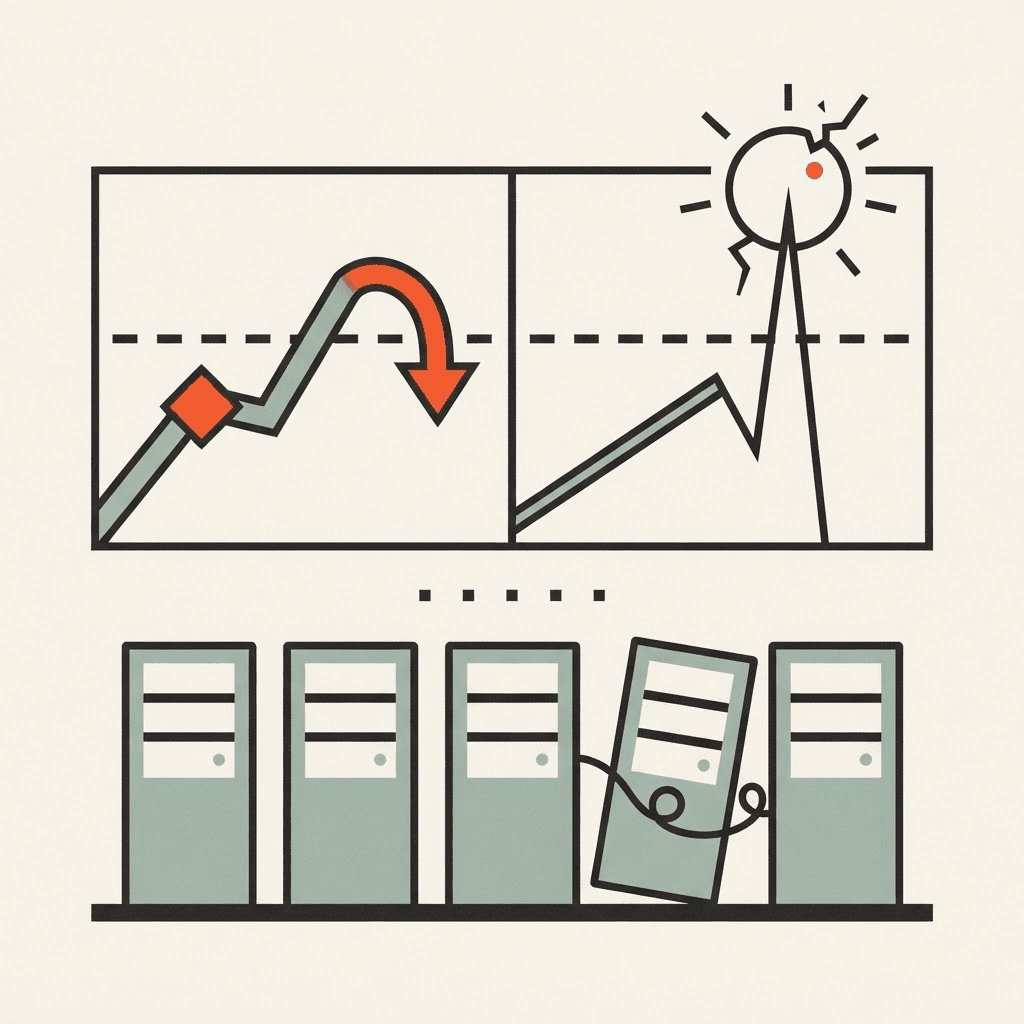
If you are shopping for a Production Ops Agent that does preventive issue prediction, the right way to shortlist vendors is to score them on one thing above all: do they act on degradation before an alert fires, or do they wait for the page and react faster? Preventive issue prediction is not a feature you bolt onto an alert queue. It is an architectural posture, so the vendors worth your time are the ones that instrument the environment, generate high-signal telemetry, and catch degradation trending toward failure before a threshold trips. Everything else on a datasheet is secondary to that distinction.
This piece gives you the evaluation criteria that separate genuine prevention from repackaged reactive triage, and a comparison table you can lift straight into your own vendor scorecard.
What does "preventive issue prediction" actually mean in a Production Ops Agent?
Preventive issue prediction means an agent detects a degradation that is heading toward customer impact and acts on it before an alert would normally fire, ideally before anyone is paged. A Production Ops Agent is a platform of specialized agents, orchestrated as one, that runs across the full operational lifecycle: preventing incidents before the page, resolving them autonomously when they happen, and operating production in between.
Prevention changes which pages happen, while reaction only changes how fast the page is answered.
A tool that fires only after an alert trips, no matter how fast its investigation, is a reactive responder, not a preventive one. The category NeuBird AI describes as "Prevent" is specifically about catching degradation early, before a threshold event, so most incidents never escalate into a war room.
The trap most buyers fall into is assuming any AI agent pointed at their monitoring stack is preventive. In practice, many are webhook-triggered: an alert fires, the agent investigates, a human approves a fix. That is valuable, but it inherits whatever noise your alert queue already had. As NeuBird AI frames it, "DIY on noise is still noise." If detection is not high-signal at the source, an agent sitting on top of it just automates chasing noise.
What criteria separate preventive vendors from reactive ones?
Use a small number of criteria that actually discriminate. Feature-count comparisons do not. The criteria below are the ones that reveal whether a vendor prevents issues or only reacts to them faster.
| Evaluation criterion | Preventive Production Ops Agent | Reactive SRE agent / copilot |
|---|---|---|
| Trigger | Detects pre-threshold degradation and acts before the page | Wakes up only when an alert already fired |
| Signal quality | Instruments the environment to generate high-signal telemetry | Consumes whatever alerts already exist, noise included |
| Operational scope | Prevent, Resolve, and Operate across the lifecycle | Investigation and triage after an incident starts |
| Autonomy | Acts under human guardrails, does not just suggest | Waits to be asked, or proposes and waits for prompting |
| Root-cause approach | Shows the causal chain across many parallel sources | Correlates coincident signals, may guess from raw logs |
| Deployment | On-prem, in-VPC, hybrid, or air-gapped options | Often SaaS-only, data leaves your environment |
| Cost model | Token-efficient, curated context, no per-log-line fees | Can hit token-cost walls at production scale |
The single most revealing question to ask any vendor: "Show me an incident you prevented that never generated an alert." A preventive agent has an answer. A reactive one changes the subject to faster mean time to resolution.
Why does telemetry quality decide whether prevention is even possible?
Prevention is impossible on top of broken signals, so the vendor's relationship to your telemetry is a first-order evaluation criterion, not a footnote. Most production environments are instrumented by generic auto-instrumentation plugins that follow framework conventions rather than business risk. The result: the bottom of the observability pyramid floods with low-value host and network noise, while the top tiers that actually dictate business survival, application SLOs and end-user experience, stay blind.
A vendor that only reads your existing alerts inherits that blindness. A preventive vendor works upstream. NeuBird AI describes this as agentic instrumentation: the agent instruments the environment and generates the right signals so the alert is high-signal by design. Practical gaps a preventive agent should be able to close include risky external dependencies left as opaque spans, high-cardinality noise inflating storage bills, unmonitored background jobs and queue consumers, broken trace context across async boundaries, and default sampling that weights a healthy 200 OK the same as a system failure.
The takeaway for your scorecard: evaluate what a vendor does to the signal before it reasons, not just what it does with the signal after an alert.
How should deployment model factor into vendor selection?
Deployment model is a hard filter for many buyers, especially in regulated industries, because a preventive agent needs continuous, deep access to your live environment. That access is far easier to grant when the agent runs where your data already lives. NeuBird AI brings the Production Ops Agent to every enterprise deployment model that matters for security-conscious teams: on-prem, in-VPC, hybrid, and air-gapped, with a human-in-the-loop architecture that does not retain telemetry in bulk.
The distinction to score is straightforward. A SaaS-only vendor requires you to ship production telemetry outside your perimeter to feed its prediction models. An in-environment vendor reasons over live context inside your walls, and the knowledge it builds about your topology stays there. For financial services, healthcare, energy, and other regulated buyers, that is often the deciding factor before any prevention capability is even evaluated.
Lead your security review with specifics: SOC 2 Type II certification, no bulk retention, human-in-the-loop approval on every action, and a full audit trail. "Enterprise-grade security" as a phrase tells you nothing.
How does NeuBird AI approach preventive issue prediction?
NeuBird AI is a Production Ops Agent platform whose Prevent pillar is built specifically for preventive issue prediction: it fixes the underlying issue through agentic instrumentation and uses sentinel scanning to catch degradation trending toward failure before a threshold trips. Its Prevent capability catches degradation 30 to 60 minutes early and delivers 80% fewer P1 war rooms. When something does break, it delivers a 2-minute root-cause analysis (RCA) at 94% RCA accuracy, querying 15+ monitoring sources in parallel across 50+ tool integrations.
If you are comparing NeuBird AI against a named alternative, the NeuBird AI vs Resolve AI comparison walks through the resolve-led versus full-lifecycle distinction, and the AI SRE Agent vs Production Ops Agent explainer unpacks why a reactive responder and a preventive agent are different categories, not different price points. These are the two comparisons that most directly map to a preventive-issue-prediction shortlist.
The positioning matters for your evaluation because it is a category claim, not a feature claim: a reactive SRE agent makes the page shorter, while a preventive Production Ops Agent aims to make the page not happen.
What is the practical shortlist test for preventive issue prediction?
Boil your vendor evaluation down to a repeatable test you can run in every demo, so you are comparing prevention to prevention rather than datasheet to datasheet.
| Test | What a preventive vendor should demonstrate |
|---|---|
| Pre-alert detection | A real degradation caught before any threshold-based alert fired |
| Signal generation | Evidence the agent improved or generated telemetry, not just read it |
| Full lifecycle | Behavior across Prevent, Resolve, and Operate, not one narrow stage |
| Causal transparency | An audit-ready causal chain, not a coincident-metric guess |
| Deployment fit | The exact model your security review requires, in-environment if needed |
| Cost at scale | A token-efficient architecture that survives thousands of tasks a day |
Score each vendor on all six. A vendor that only clears the last four is a competent reactive responder. A vendor that clears the first two as well is doing genuine preventive issue prediction. For most engineering organizations drowning in 2am pages and multi-tool war rooms, that first pair of rows is the entire reason to buy, because it is the difference between recovering from incidents faster and getting your best people back on the roadmap.