Your Engineering Team Is a Crew of Agents Now. Who's On Call When They Break Prod?
AWS Kiro Crew makes agent engineering teams real. The ops question nobody's asking: when agents ship 24/7, who owns production?
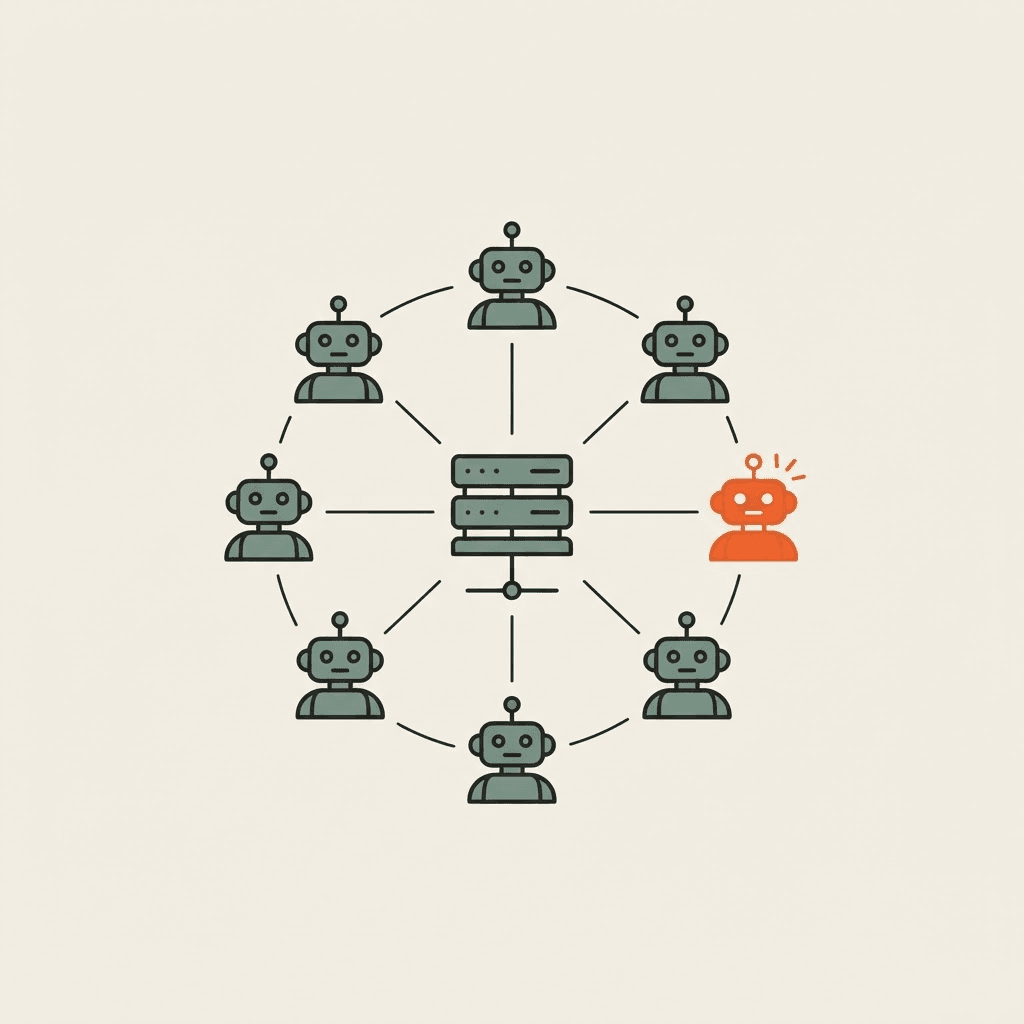
On August 4, AWS shipped Kiro Crew. It turns Kiro coding agents from single-session assistants into persistent, multi-agent engineering workflows. Agents that keep context across sessions, run scheduled and recurring work, coordinate in parallel, and keep going while you are asleep or in a meeting.
That is a real shift. And it raises a question the launch coverage mostly skips. When a crew of agents ships changes around the clock, who is on call when one of them breaks prod? The short answer is still you. The longer answer is that autonomous engineering teams need autonomous production operations to match, and governance controls alone do not get you there.
What exactly is Kiro Crew?
Kiro Crew is an open-source orchestration layer. Per the Kiro announcement, it adds checkpoints, validation, retries, webhooks, and heartbeat monitoring on top of coding agents. Its reference apps cover worktree management, issue and pull-request triage, and long-running engineering jobs.
Crew started inside Amazon as a side project called MeshClaw, and by Kiro's own numbers it picked up more than 39,000 Amazon builders in under six months. It runs locally or on a remote machine you control, with no managed control plane required, though the runtime is wired to the Kiro CLI at launch.
Why should production operators care?
Here is what actually changes. Instead of one developer prompting one agent and reviewing one result, a crew can triage queues, investigate across repositories, watch pull requests and deployments, and run migrations overnight. That means more changes entering your systems faster, with more connections between them.
More change velocity is not automatically bad. But the failure surface grows with it. And agent failures do not look like the crashes your runbooks were written for.
An agent can pick the wrong worker. It can call the wrong tool. It can pass malformed arguments. It can loop through retries without making progress. It can quietly fall back to model memory. It can lose state across a session. None of that shows up as a stack trace. Catching it needs end-to-end traces, evaluations, explicit budgets, stopping conditions, and idempotency controls. Code review does not cover it. An activity feed does not cover it.
To its credit, Kiro Crew ships meaningful controls: sandboxing, denied commands, sensitive-path protection, credential redaction, tool-approval gates, live activity visibility, and signed audit logs. Those answer a governance question. What did the agent do, what did it touch, who approved it?
That is not the same as the production-operations question.
Governance is not observability
The governance question and the ops question look similar and are not. Approval gates and audit logs tell you what an agent did. They do not tell you whether the resulting change degraded latency, raised error rate, ate into capacity, or hurt the customer. They do not tell you whether several agents made changes that interact badly. They do not tell you who is accountable when a background workflow crosses a service boundary at 3am and nobody was watching the original run.
That gap is the whole point. Autonomous engineering needs production observability and operational governance inside the execution loop, not stapled on afterward. Coding agents have shortened implementation time while making production behavior harder to diagnose. As a recent Arize analysis puts it, traces are the source of truth for the path an agent actually took. Speed without production visibility is just risk arriving faster.
The loop has to tighten to the same four steps whether a human or an agent wrote the change: ship, observe, debug, improve.
So who is on call? Still you.
Let's be precise about the claim, because the hype will overshoot it. AWS has not handed production to an unsupervised agent swarm. Kiro Crew can investigate incidents and watch deployment or CI state. Nothing in the launch materials shows it taking end-to-end production ownership or replacing a human on-call rotation.
Humans are still accountable. The near-term requirement is unglamorous and correct: a human owner for every agent-created change, least-privilege access, explicit approval policies, auditable provenance, bounded autonomy, and a production feedback loop that actually closes.
There is a fair caution here too. Crew adds another orchestration layer that enterprises have to manage and secure, with policies for least privilege, approvals, memory retention, code provenance, and auditability. Many teams are not operationally ready to run swarms of autonomous agents. That readiness gap is the real story.
This is where autonomous production operations belongs in the picture. If agents can continuously create and modify software, the operating side needs an equally deliberate system for tracing decisions, correlating changes against live service behavior, enforcing ownership boundaries, and resolving failures when no human was in the loop for the original work. That is the kind of problem context engineering exists to solve: reasoning over what actually happened in the live environment instead of guessing from a wall of raw signals. It also gets harder when agents themselves start collaborating to resolve issues, because now the chain of decisions spans more than one autonomous actor. The good news is that a lot of this thinking is not new: teams that already treat instrumentation as a first-class discipline, as covered in work on stabilizing AI engineering, have a head start.
The take
Kiro Crew is not overreach. It is a concrete step from AI-assisted coding to persistent, background engineering. That step is useful, and it makes a missing operating model urgent rather than theoretical.
The uncomfortable pattern is that we keep pointing new automation at old plumbing. Agents shipping changes 24/7 will generate more alerts, more deploys, and more interacting failures, and most of that noise will land on the same on-call rotation and the same four-plus tools per incident that were already overwhelming people. Faster development without matching operations does not remove the toil. It relocates it and speeds it up.
Autonomous engineering teams need autonomous production ops to match. Governance and observability are not add-ons here. They are the game. The teams that adopt agent crews and stand up a real ship-observe-debug-improve loop will pull ahead. The teams that adopt the crews and skip the loop will spend 2026 debugging decisions no human made, with the receipts but not the answers.
Sources: Kiro: Introducing Kiro Crew · Kiro: Crew · Arize: How to debug production AI agents with Signal