Why AI Dev Spend Is the Next Ops Problem
Google's spend caps on Antigravity signal that agentic coding workloads behave like production infrastructure, not SaaS seats.

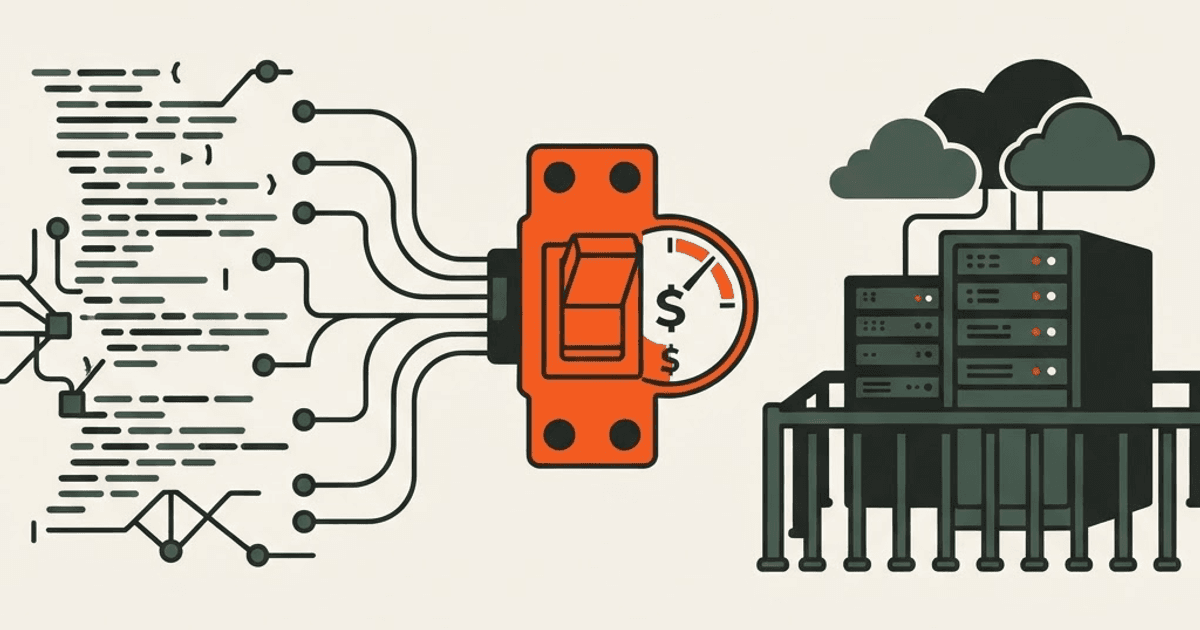
Google just gave its autonomous coding tool a budget cop. On August 20, 2026, Antigravity moved into eligible Gemini Enterprise subscriptions with a control layer built around one idea: these agents will spend money, and you need a way to stop them. That is worth paying attention to, and not for the reason the billing team thinks.
What actually happened
Google folded Antigravity into Gemini Enterprise Standard, Plus, and Standard Emerging Market licenses, and brought it into existing dev environments through preview extensions for VS Code, Visual Studio, JetBrains, and Zed. The stated goal is to pair autonomous coding with centralized identity, security, usage visibility, and cost management.
The interesting part is the control plane, per Google's Antigravity Enterprise announcement and its Google Cloud writeup. Administrators can set monthly project-level spend caps, pool token quotas across users, monitor token consumption, API calls, and developer activity, and optionally allow capped overages at pay-as-you-go rates. Per-user and team-level controls are slated for later in 2026, so the initial enforcement point is mostly the project.
A cap is not just an alert. Per Google's budgets and spend caps documentation, when a cap is enforced, new requests to eligible services are paused and additional usage stops accruing. If admins enable overages, work continues under a configured limit at consumption pricing, as described in the quotas and overages docs. Google also added sandboxing, browser and MCP-server restrictions, Workforce Identity Federation, Application Default Credentials, and centralized audit logging for prompts, tool executions, and generated artifacts.
Why this is an ops story, not a finance one
Antigravity is not autocomplete. Its agents research codebases, run local builds, operate browsers, execute terminal commands, and perform multi-step engineering work. That autonomy is exactly what makes spend spiky and hard to forecast.
Stack a few of those handoffs, add premium-model selection and retry loops, and an unsupervised chain can drain a shared team pool fast. As an InfoWorld analysis of the launch makes clear, AI coding spend is starting to look like a cloud bill rather than a SaaS seat charge. It is metered, usage-sensitive, multi-vendor, and capable of surging with no change in headcount.
Here is the part that should get an SRE's attention. The financial risk and the operational risk are the same risk. An agent that can reach a repository, a CI system, a browser, an MCP server, or a cloud project can also produce production-side effects. A bad permission, a runaway loop, a retry storm, an oversized context, or an uncontrolled handoff can simultaneously burn budget, exhaust a quota, spin up infrastructure, and widen the blast radius of an incident. The New Stack coverage frames it plainly: once an agent connection reaches a production system, a bad setting can have serious consequences.
Google has not announced an outage or a confirmed bill shock. It shipped the guardrails because the cost and risk profile changed. The developer tool became an agent workload, and agent workloads behave like production infrastructure.
The license portal is not your control plane
Spend caps at the subscription level are a real backstop. They can pause requests, attribute consumption to a team, and protect the P&L from an unexpected bill. They do not, by themselves, govern every action an agent takes at the production boundary.
That is the gap. A billing cap knows how many tokens an agent burned. It does not know whether the agent should have had write access to that cluster, whether a retry loop was about to create fifty ephemeral resources, or whether a change should have gone through a controlled Git and CI/CD path instead of a broad cloud credential. Cost governance answers "how much," not "what did it just do."
Production needs its own runtime control plane, independent of the license portal. That means scoped identity instead of broad credentials, tool and network policy, concurrency and rate limits, resource quotas, full auditability, reversibility, and an immediate kill switch. Agent requests should pass through that layer rather than receiving the keys to the environment. This is where spend protection stops being a finance nicety and becomes an operations discipline, and it is the same reasoning behind why a production ops agent runs inside your environment under your guardrails rather than reaching in from the outside.
This is a category shift, not a config toggle
The deeper point is that autonomous agents are becoming a first-class operational workload, and the tooling around them has to grow up accordingly. That is the argument for treating the production operations agent as its own category: the thing running work in your environment needs the same governance posture as any production system, not the lighter treatment a SaaS seat gets. It is also why the runtime governance conversation looks different from the observability-and-billing conversations that dominated the last decade of platform tooling, a distinction worth keeping in view when you compare where the AI moment actually lives in the stack. If you are still sorting out how these agents behave once they are in production, it also helps to look at where an ops agent sits relative to the monitoring layer.
The take
Granular spend controls on AI coding tools are an admission, not a feature. They are the industry conceding that unbounded agentic workloads will blow up your cloud bill and your runbook at the same time. Seat-based license management assumed a fixed unit of consumption per human. Agents broke that assumption.
So treat AI dev spend the way you already treat production capacity. Budget it, quota it, and observe it, but do not stop at the invoice. The dollars are a lagging indicator of what the agent is actually doing. If you can cap the spend but cannot scope the actions, revoke the access, and reverse the change, you have half a control plane. The billing cop tells you the money is gone. It does not tell you the cluster is gone too.
Sources: Antigravity - Antigravity Enterprise · Google - Expanding Google Antigravity For Enterprise Customers · Google - Quotas And Overages · Google - Budgets Spend Caps · Thenewstack - Google Antigravity Ide Extensions · Infoworld - Google Brings Antigravity Under Gemini Enterprise To Provide · Google - Flexible Billing And Cost Controls For Agents On Google Clou · Qovery - Ai Tech Stack 2027 Seven Layers · Dataiku - Agentic Ai Governance Frameworks