The Hidden Waste Inside Most AWS Environments
A synopsis of NeuBird AI's 'Ultimate Guide to AWS Cost Optimization' examining the operational patterns driving unnecessary AWS spend across compute, storage, networking, EKS, logging, and data growth.

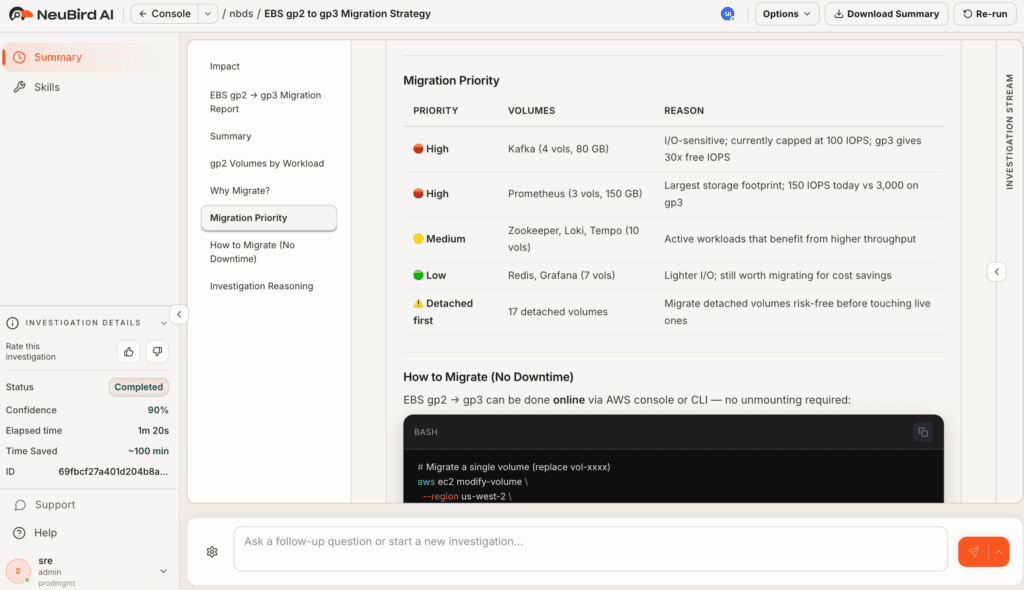
This blog is a synopsis of NeuBird AI's "Ultimate Guide to AWS Cost Optimization" white paper, a deep dive into the operational patterns driving unnecessary AWS spend across compute, storage, networking, EKS, logging, and data growth.
The reality is that most AWS waste does not come from one major mistake. It comes from hundreds of small inefficiencies quietly compounding over time. According to a McKinsey and Company report, organizations can "reduce cloud costs by as much as 20-30 percent."
Idle infrastructure. Oversized databases. Forgotten backups. Cross-AZ traffic. NAT Gateway sprawl. S3 data sitting in premium storage tiers long after anyone accesses it.
The bigger challenge is that most organizations already have visibility into spend. What they lack is operational context.
Teams can see costs increasing. They still struggle to answer:
- What changed?
- Which workloads are actually wasting money?
- Is this growth expected or accidental?
- Which resources are oversized or idle?
- What action should we take next?
That is why AWS cost optimization is shifting from a finance exercise to an operational intelligence problem.
Over-provisioned Compute and Databases
One of the largest and most persistent cost drivers in AWS is overprovisioning.
This shows up everywhere:
- EC2 instances running at single-digit CPU utilization
- Over-sized RDS Oracle, SQL Server, PostgreSQL, and Aurora databases
- Kubernetes (EKS) worker nodes sized for peak demand
- Lambda functions with excessive memory allocation
- Dev and test environments running continuously
These workloads are rarely revisited after deployment, which means excess capacity quietly becomes permanent monthly spend.
Organizations that actively optimize EKS could see "20-40 percent reduction in EKS-related infrastructure costs," especially in environments with limited prior optimization.
Storage Growth Becomes Invisible Spend
Storage and backup costs accumulate slowly, which makes them easy to ignore until they become material.
The most common patterns include:
- Unattached EBS volumes
- Old AMIs and snapshots
- Redundant backups across accounts and regions
- CloudWatch logs without retention policies
- S3 buckets without lifecycle policies
- Cold data sitting in expensive storage tiers
Many organizations continue paying S3 Standard pricing for data that has not been accessed in months. Moving infrequently accessed data from S3 Standard to S3 Standard-Infrequent Access or Glacier tiers can "reduce costs 40 to 80 percent" depending on access patterns and retention requirements.
Network Costs are Often the Biggest Surprise
Network and data transfer costs are among the hardest categories to optimize because they are tied to architecture behavior rather than individual resources.
Common hidden cost drivers include:
- NAT Gateway overuse
- Cross-Availability Zone traffic
- Cross-region transfers
- Public endpoint communication
- Excess outbound internet egress
- Inefficient load balancer usage
- Lack of CDN or caching layers
In distributed cloud-native environments, these costs compound rapidly and are often difficult to trace back to a specific workload or design decision.
Why Traditional Cost Tools Fall Short
AWS Cost Explorer and Trusted Advisor are valuable, but they are fundamentally visibility tools. They show teams where money is being spent. They do not continuously investigate:
- Why costs changed
- What operational event introduced waste
- Which workloads are driving inefficient behavior
- Which actions will have the greatest impact
That investigative gap is where operational AI becomes important.
NeuBird AI's Production Ops Agent continuously analyzes telemetry, infrastructure utilization, storage growth, traffic patterns, configuration drift, and workload behavior in real time. Instead of static reports, teams can investigate cost issues conversationally using plain-English prompts.
12 High-Impact NeuBird AI Prompts
The following prompts can be used within the NeuBird AI Web Interface or Terminal User Interface to find AWS cost savings opportunities.
Rightsizing and Idle Resources
- Which EC2 instances have CPU utilization below 10 percent over the past 2 weeks?
- Which RDS instances have low connections or CPU usage and can be downsized?
- Which Lambda functions have memory allocation significantly higher than actual usage?
Storage, Logging, and Backup
- List all unattached EBS volumes with size and estimated monthly cost.
- Which S3 buckets do not have lifecycle policies configured?
- Are CloudWatch log groups accumulating without retention policies?
Network and Data Transfer
- Which NAT Gateways are generating the highest cost?
- Identify cross-Availability Zone traffic contributing to cost.
- Which workloads are generating the highest outbound data transfer to the internet?
Reserved Capacity and Spend Alignment
- Which workloads should move from On-Demand to Savings Plans?
- Identify underutilized reserved capacity across my environment.
Governance and Cost Control
- Show services with the fastest cost growth over the past 30 days.
From Reactive Reviews to Continuous Optimization
One of the most important shifts happening in cloud operations is the move away from periodic cost reviews toward continuous optimization.
Cloud environments never stop changing: new services get deployed, storage expands, Kubernetes clusters scale, traffic patterns evolve, logging increases, and teams provision new infrastructure daily. Without continuous operational intelligence, waste naturally returns over time.
That is why NeuBird AI approaches optimization as part of daily operations rather than a quarterly cleanup exercise. The Production Ops Agent continuously surfaces inefficiencies, explains cost impact, identifies likely causes, and recommends next actions before costs spiral further.
Final Thoughts
AWS cost optimization is no longer just about reporting on spend after the fact. The organizations achieving the biggest savings are the ones continuously investigating operational inefficiencies in real time across compute, storage, networking, Kubernetes, and cloud architecture itself.
The "Ultimate Guide to AWS Cost Optimization" white paper goes much deeper into the operational patterns, savings opportunities, architecture considerations, and AI-driven optimization strategies shaping modern cloud operations.