The Cost of Building a DIY Agent
Why building custom AI SRE agents internally often becomes more expensive and complex than anticipated, and how cost, speed, and accuracy are constantly in tension.

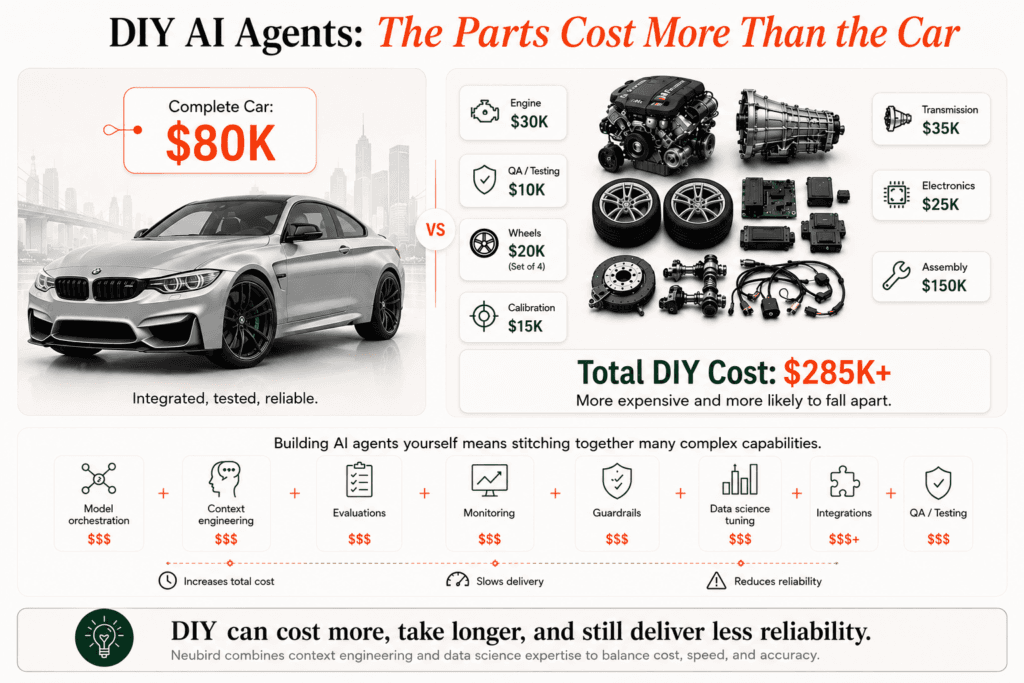
Building an AI SRE agent is not just a matter of connecting an LLM to your observability stack and hoping it can reason through incidents. The real challenge is balancing three forces that are constantly in tension: cost, speed, and accuracy. Push too hard on speed, and accuracy suffers. Optimize only for accuracy, and costs can spiral. Focus only on cost, and the agent may become too shallow to be useful in real production environments.
At NeuBird AI, we have spent years working through this balance. Our AI SRE agent is built on deep context engineering, production-grade integrations, and continuous tuning by a dedicated team of data scientists. That matters because an effective SRE agent needs to understand not just logs, metrics, traces, and alerts, but also the operational context around them: what changed, what matters, what is normal, what is risky, and what action is actually useful.
Why Do DIY AI SRE Agents Cost More Than Teams Expect?
This is where many DIY agent efforts run into trouble. On the surface, building your own AI agent can look cheaper. The ingredients are available: models, orchestration frameworks, retrieval pipelines, monitoring tools, guardrails, evals, and integrations. But once teams start assembling all of these pieces themselves, the economics begin to change.
The hidden work is not in getting a demo to run. It is in making the system accurate, fast, reliable, secure, and cost-efficient at production scale.
A useful analogy is buying a car. You might pay $80,000 for a complete, engineered vehicle that has already been integrated, tested, calibrated, and made reliable. But if you tried to build that same car by purchasing each part separately (the engine, wheels, transmission, electronics, assembly, calibration, and testing) the total cost could easily exceed the price of the finished car. Worse, the final result may still not perform like a factory-built vehicle.
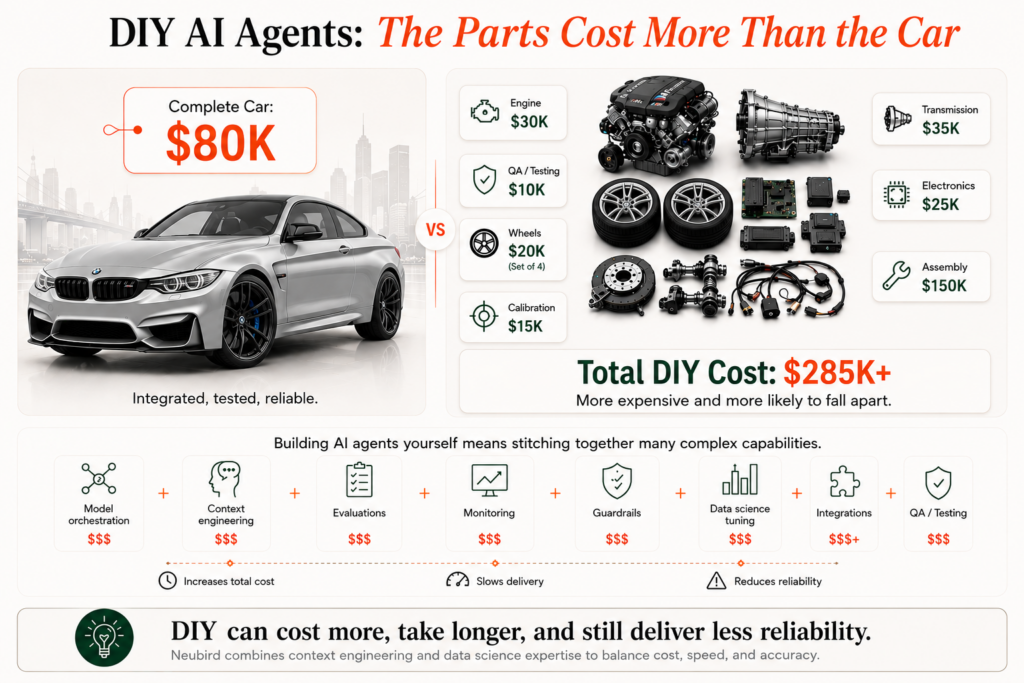
DIY AI agents often follow the same pattern. The model is only one part of the system.
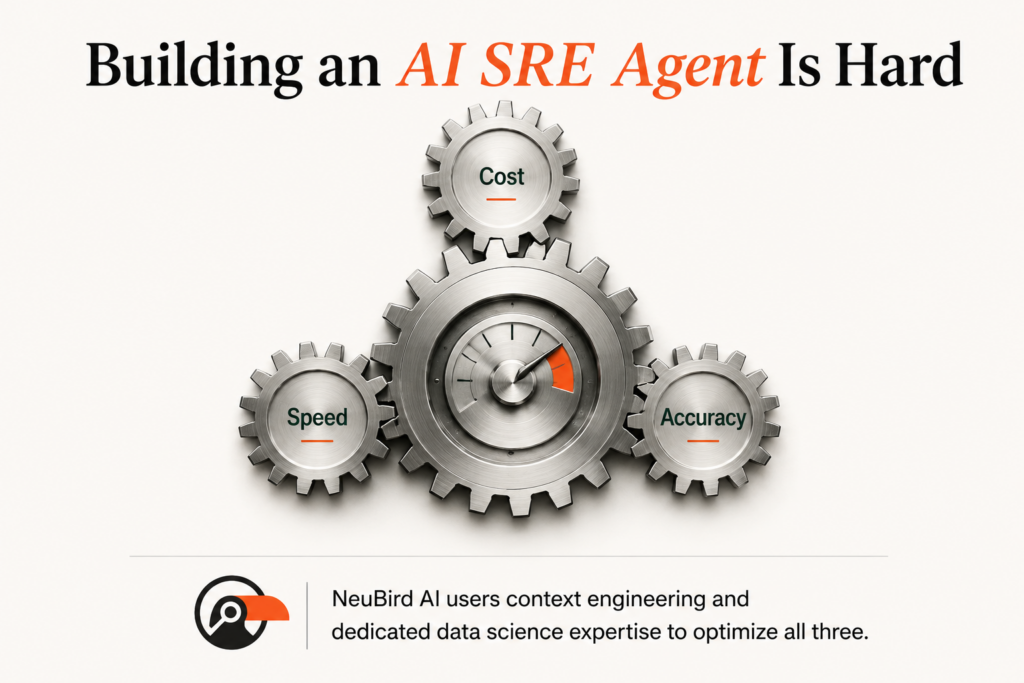
You also need context engineering, data pipelines, domain-specific evaluations, observability, security controls, feedback loops, incident workflows, and ongoing tuning. Each piece adds cost. Each integration adds complexity. Each shortcut introduces risk. By the time the system is production-ready, the "cheaper" DIY approach may have become more expensive, slower to deliver, and less reliable.
What Does a Production-Ready AI SRE Agent Actually Require?
For infrastructure and operations teams, reliability is the product. An AI SRE agent cannot simply produce plausible explanations; it must provide accurate reasoning, reduce noise, accelerate root cause analysis, and help teams act with confidence. That level of performance requires more than stitching tools together. It requires a system designed from the ground up to balance cost, speed, and accuracy in real-world operational environments.
That is the difference NeuBird AI is focused on. We bring together context engineering, data science expertise, and production SRE workflows into a purpose-built AI SRE agent. Instead of asking teams to assemble the parts themselves, NeuBird AI delivers the integrated system: tested, tuned, and ready to help operations teams move faster with greater confidence.