Red Hat Ansible Automation Platform: AI Runbook Automation
NeuBird now integrates with Red Hat Ansible Automation Platform, so AI investigation maps root cause to the Ansible job templates your team already runs.

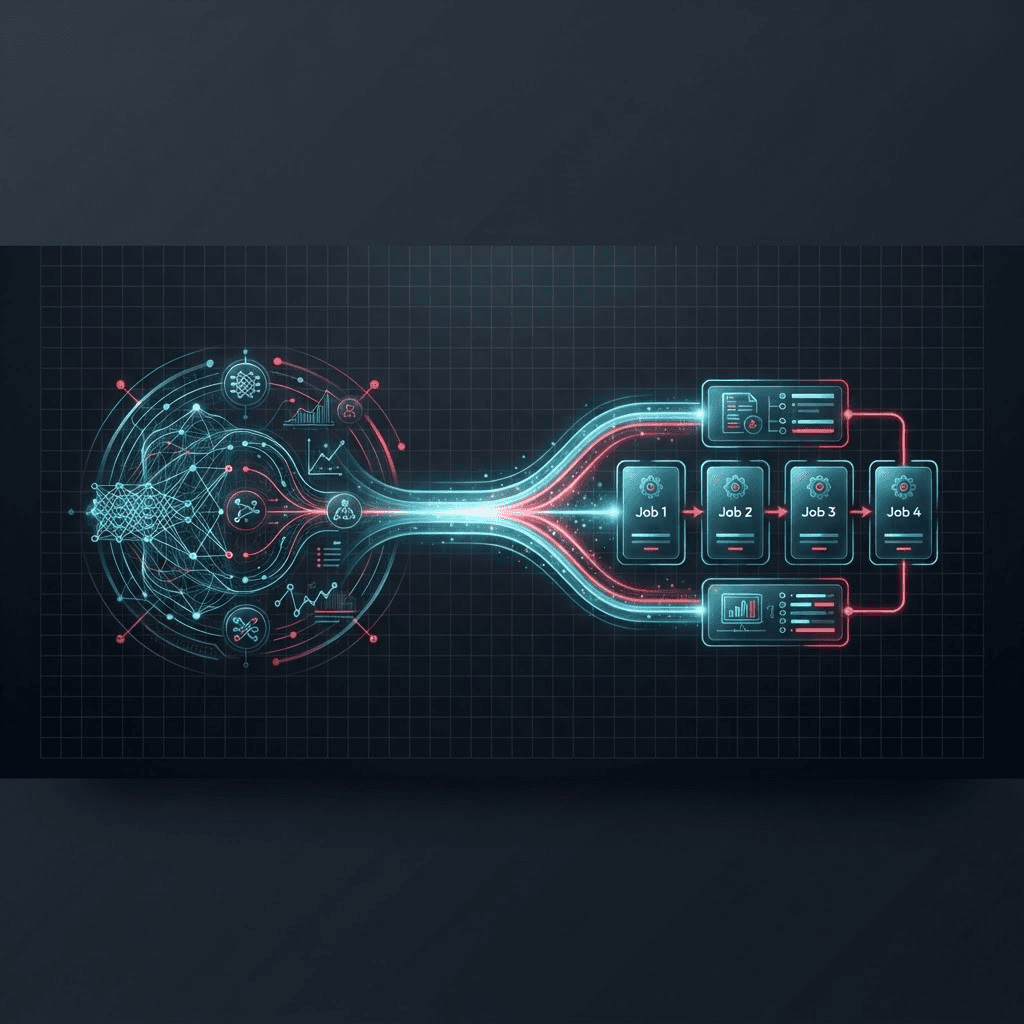
NeuBird now integrates with Red Hat Ansible Automation Platform, connecting AI-driven investigation directly to deterministic, repeatable remediation. Available as a Red Hat Ansible Certified Collection in the Ansible automation hub, this integration brings AI runbook automation to production operations. It pairs autonomous root-cause analysis with the trusted Ansible job templates your team already runs. Teams can start by triggering those templates by hand after an investigation and move to automatic execution as individual templates are approved for a safe-to-run list.
In modern cloud environments, production complexity often overwhelms traditional operational workflows. When a critical service degrades or a risk audit flags an infrastructure oversight, teams are routinely pulled into multi-tool war rooms to diagnose the root cause and apply a manual fix.
While observability tools notify engineers when something breaks, they leave both the investigation and the fix to human troubleshooting.
The Operational Gap: Bringing Action to Investigation
Identifying a problem is only part of the incident lifecycle.
During an investigation or routine risk audit, NeuBird's Production Ops Agent can identify that an AWS RDS database instance lacks deletion protection or multi-AZ redundancy. It can also highlight that a service is down due to a frozen virtual machine.
NeuBird focuses on intelligent investigation and analysis:
- Autonomous Investigation: It queries telemetry across 15+ sources in parallel to pinpoint root causes in under 5 minutes at 94% accuracy.
- Actionable Recommendations: It surfaces clear, context-aware remediation paths based on real-time system state.
However, executing infrastructure changes like modifying database settings or restarting virtual instances requires predictable, controlled execution. That is where Red Hat Ansible Automation Platform comes in.
How It Works: Connecting Recommendations to Repeatable Execution
NeuBird connects to the Ansible Automation Platform via an open Model Context Protocol (MCP) server connection. Through that connection, NeuBird matches its investigative findings directly with your existing Ansible Job Templates.
The Integrated Workflow
- Contextual RCA & Risk Auditing: NeuBird continuously monitors telemetry and performs risk audits across your infrastructure to surface degradations and configuration oversights before they cause wider disruptions.
- Template Mapping: When an issue or audit finding is identified, NeuBird queries Ansible Automation Platform via the MCP server connection to see if a corresponding Ansible job template already exists to address it.
A Graduated Path to Autonomy
- Human-in-the-Loop Verification: Teams can start by reviewing NeuBird's recommended remediation and manually triggering the matching Ansible job template directly as a follow-up to the investigation.
- Automated Remediation: As confidence in specific playbooks grows, teams can place proven templates on a "safe-to-run" list. NeuBird can then trigger these Ansible job templates automatically upon detecting a matching finding.
- Standardized Job Execution: Once triggered, Ansible Automation Platform executes the template as a tracked job, so infrastructure updates remain consistent and fully audited.
If NeuBird identifies an issue where no corresponding template exists, it highlights the gap so administrators can author new Ansible content to automate future fixes.
What This Collaboration Hints at the Future of Ops
By connecting NeuBird's contextual reasoning with Ansible Automation Platform's deterministic orchestration, role-based access control (RBAC), and audit trails, organizations can take progressive steps toward automated recovery:
- A Pragmatic Bridge to Self-Healing: Self-healing operations don't happen overnight. Pairing intelligent AI diagnosis with deterministic Ansible execution gives teams the safety rails needed to automate more over time.
- Standardized & Safe Operations: Standardizing fixes through Ansible Playbooks reduces ad-hoc, error-prone manual commands during high-stress incidents.
- Operational Efficiency: Streamlining the transition from diagnosis to action helps minimize alert fatigue, reduce war room time, and reclaim engineering hours for product development.
- Data Sovereignty & Control: NeuBird operates inside your environment (on-prem or in-VPC) with no bulk telemetry retention, enabling complete machine auditability and human-in-the-loop control.
What AI runbook automation means for production operations
AI runbook automation pairs AI-driven investigation with codified, repeatable remediation, so that a diagnosis flows directly into execution. Today an engineer reads an alert, finds the right runbook, and runs it by hand. Each of those steps adds minutes to an incident. AI runbook automation closes that handoff into a single governed path.
NeuBird is a governed platform, one governed platform, and the Production Ops Agent runs on it as a workload. The agent analyzes 15+ sources in parallel, isolates root cause in under 5 minutes at 94% accuracy, and maps the finding to the matching Ansible job template over MCP. Ansible Automation Platform then executes that template as a tracked job, so the remediation is deterministic and repeatable every time it runs.
Autonomy works as a dial with three settings: Suggest, Recommend, and Act. At Suggest and Recommend, the agent surfaces the matching template and an engineer decides whether to trigger it. At Act, templates the team has placed on the safe-to-run list run automatically when a matching finding appears. Human approval stays on every action, either at the moment of triggering or in advance when a template is added to the list. Teams set the dial per class of fix and move a template from Recommend to Act as confidence in that playbook grows.
NeuBird also records the conclusions of each investigation as institutional operations memory with no bulk telemetry retention. The memory holds causal chains and approvals; raw logs and traces stay in your own systems. When the same failure recurs, the agent starts from the recorded conclusion, so each failure is solved once and the matching template is reached faster the next time.
Does NeuBird replace your existing Ansible playbooks?
NeuBird reuses the Ansible job templates and playbooks your team already runs. The remediation layer stays yours: the templates, the RBAC that governs who can run them, and the audit trail of every execution all remain in Ansible Automation Platform. NeuBird's role is to investigate, surface the right remediation, and connect that recommendation to the correct template. Execution still runs through Ansible, so a fix triggered from an investigation is tracked and governed the same way as one an engineer launched by hand.
When no matching template exists, NeuBird highlights the gap so administrators can author new Ansible content to automate future fixes. Each unfamiliar incident becomes a codified remediation that the next investigation can map to directly.
Getting Started
Red Hat customers can explore the integration today:
- Download the Collection: Access the NeuBird collection in the Ansible automation hub.
- Connect Your Stack: Connect NeuBird to your cloud infrastructure and link Ansible Automation Platform using MCP.
Watch the video demonstration here or visit neubird.ai to request a demo.