Telemetry Dashboards are Obsolete
How to upgrade from observability to actionability. Telemetry Dashboards are Obsolete by NeuBird AI.

How to upgrade from observability to actionability
If you could only pick one tool for software development, Claude or Stack Overflow, which would you choose?
That wasn't a hard question, was it? Stack Overflow traffic collapsed by 50% following ChatGPT's launch in late 2022 (VentureBeat). AI didn't just disrupt Stack Overflow. It made us rethink our choice of tools in many different areas.
Now ask yourself the same question about your IT Incident Response tooling.
If you could only pick one approach to understanding and fixing production issues, which would you choose? An AI agent that can reason across your entire telemetry stack, or your Datadog dashboards?
The Revolution That Already Happened
Let's acknowledge the past. Datadog changed the observability game. Before Datadog, engineering teams were drowning in tool sprawl: one tool for metrics, another for logs, another for traces, yet another for alerting. Datadog centralized all of that into a single platform under a unified data model with over 1,000 integrations (Datadog). That was genuinely revolutionary and the market rewarded it with $2.68 billion in revenue in fiscal year 2024.
But that revolution was mostly about observability: centralizing data and making it visible. The core innovation was "all your telemetry in one place, beautifully rendered." The consumption model was still a human being opening a browser, staring at panels, and reasoning through what the pretty graphs meant.
That was the right answer in 2016. It is the wrong approach in 2026.
The game has changed. The question is no longer "can I see what's happening in my systems?" The question is "can I act on what's happening, fast enough, at a scale and complexity that exceeds human cognitive capacity?"
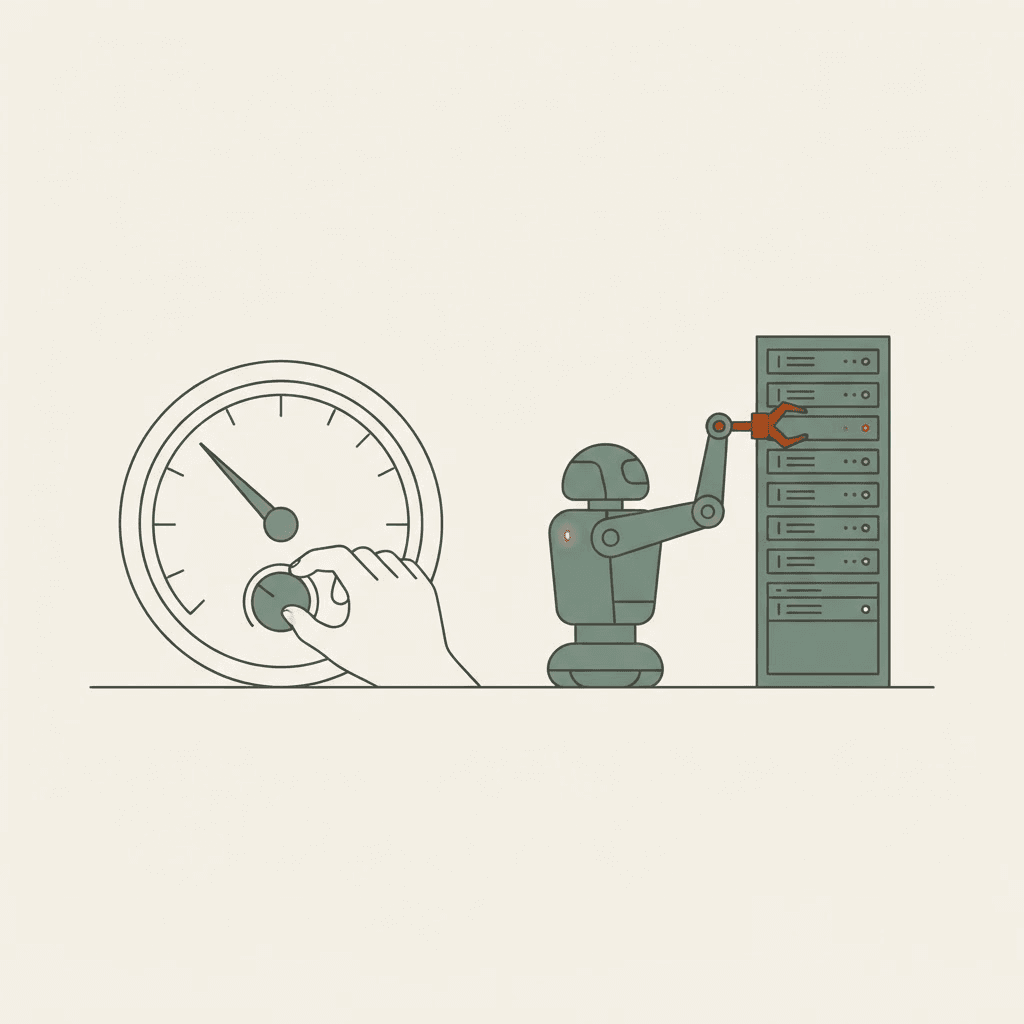
Dashboards only provide observability. Tools built on top of dashboards summarize observed data. Only the next generation of AI-native tools will provide true actionability.
Observability vs. Actionability
Observability is the ability to understand the internal state of a system by examining its outputs: metrics, logs, and traces. It answers the question: what is happening? Dashboards are the native interface for observability. They visualize data. They render time-series. They let humans scan, filter, and explore. The value proposition is visibility.
Actionability is the ability to automatically detect, diagnose, and respond to system behavior in real time, across every relevant data source, without depending on a human to be the reasoning engine. It answers a fundamentally different question: what should we do about it, and can we do it now?
Observability tells you the kitchen is on fire. Actionability puts out the fire while simultaneously telling you which burner caused it, why the smoke detector didn't trigger sooner, and that the same burner had a gas leak flagged in a maintenance ticket three weeks ago.
The problem with the observability-era is that it assumed human cognition was the bridge between data and action. Dashboards collect and display information. Then, humans observe and formulate a course of action. This worked when systems were simpler, data volumes were manageable, and the blast radius of an incident was limited. And most importantly, the pace of software development scaled linearly with the number of developers.
None of those conditions hold anymore.
Modern production environments generate telemetry at a volume and velocity that overwhelms human processing. A single Kubernetes cluster can produce thousands of metrics per second. Microservice architectures create dependency graphs with hundreds of nodes. Multi-cloud deployments scatter signals across regions and providers. And AI brings exponentially faster development and deployment cycles.
Why Dashboard-Native Products Fundamentally Can't Compete
Products built around dashboards have a specific architectural DNA. They are designed to ingest, store, and index telemetry to render it for human consumption. Every design decision, from data retention policies to query languages to UI patterns, is optimized for a human being sitting in front of a screen, asking questions, and interpreting visual answers. It simply hoards data because it is not designed to optimize for what’s valuable and what’s not. 90% or more of the data is unactionable. Yet every year, companies simply pile on more and more data and pay for every kilobyte of it.
AI-native agent platforms have completely different architectural DNA. They are designed to interpret precise data from any source, reason across it programmatically, and produce accurate remediation steps. No curated panels and no assumptions that someone needs to "see" the data before something can be done about it.
This difference isn't cosmetic. It creates at least three fundamental limitations that dashboard-native products cannot overcome by simply bolting AI features onto their existing platform.
Limitation 1: The Single-Pane-of-Glass Ceiling
Dashboard platforms pride themselves on being a "single pane of glass." But that pane only shows you what the platform ingests. And the more you ingest, the more you pay.
Real incidents don't respect vendor boundaries. The root cause of your latency spike might involve the config change documented in a Jira ticket, the deployment that went out through your CI/CD pipeline, the Slack conversation where an engineer mentioned something weird about the staging environment, the runbook your team wrote in Confluence six months ago, and the fact that a similar pattern appeared in an incident postmortem from last quarter.
A dashboard shows you a slice. An AI agent reasons across the whole picture.
AI-native platforms can integrate context from infrastructure telemetry, change management systems, team communication, documentation, incident history, and code repositories simultaneously. They don't need a panel for each data source. They don't need a human to visually correlate across 12 browser tabs. And most importantly, they don’t need to copy and store data again in a different format just to correlate information.
Limitation 2: The Reactive Trap
Dashboards are, by their nature, reactive interfaces. You open a dashboard in response to something: an alert, a customer complaint, a hunch. Even proactive monitoring features like anomaly detection still ultimately surface their findings on a dashboard that a human has to look at, interpret, and act on.
True AI-native agents flip this model entirely. They don't wait for you to open a browser. They don't surface anomalies on a panel for you to notice between meetings. They detect, investigate, and begin resolution autonomously. By the time you see the Slack notification, the agent has already correlated the symptom with the cause, checked whether the pattern matches historical incidents, and drafted a remediation plan.
Limitation 3: The Cost-Complexity Spiral
Here's where the financial argument gets brutal.
Dashboard-centric platforms charge you to ingest, index, and store data for visual consumption. The more complex your infrastructure, the more data you generate, and the higher your bill. Mid-sized companies routinely spend $50,000 to $150,000 per year on Datadog, with enterprise deployments easily exceeding $1 million annually once APM, logs, and RUM are included (Middleware, 2025). In extreme cases, a single customer has generated a $65 million annual bill, as Coinbase did in 2021 before restructuring their contract (The Pragmatic Engineer, 2023).
And what does that spending buy? Fundamentally, it buys the right for a human to look at the data. All that ingestion, indexing, and retention is in service of rendering panels that someone has to create and visually interpret. The more complex your systems get, the more data you need to ingest, the more you pay, and the harder it becomes for a human to reason across all of it. Cost scales up while human effectiveness scales down.
AI-native agents break this spiral because they don't need to render and store every metric for human visual consumption. They reason over signals. They can be selective, contextual, and efficient about which data matters for a given investigation.
AI-native agents don't require petabyte-levels of data ingestion, nor do they need a costly indexing of data which are only sampled and mostly irrelevant. They read exactly what they need, when they need it, across whatever sources are relevant for the investigation.
The result is that AI-native platforms can deliver significantly better outcomes, faster resolution, and more proactive detection while consuming much fewer resources. You're not paying to display data. You're paying for precise diagnosis and automated remediation, just when you need it most.
Verbally Describing a Painting
And this brings us to the most revealing tell of the observability industry.
Dashboard vendors know the model is breaking. They can read the same tea leaves everyone else can. So what are they doing about it? They're bolting AI onto their dashboards that summarizes the data in natural language.
These companies spent billions of dollars building sophisticated visualization platforms to display data. Beautiful charts. Real-time streaming graphs. Custom widgets. And now their big AI innovation is to convert all of that visual data back into plain English sentences.
It's like creating an elaborate art piece and then hiring someone to stand next to it and describe the intricacies. The painting was supposed to be the communication medium. If you need a translator for your translator, the original medium has failed.
But the irony goes deeper. When a dashboard vendor adds natural language querying, voice interfaces, or autonomous investigation agents, they are not enhancing the dashboard experience. They are building escape hatches from it. Every conversational AI feature is a way to not look at dashboards. And the investigation agents simply state the obvious that you can already see: latency graph goes up, user experience goes down.
The truly forward-thinking approach isn't to sprinkle AI on top of dashboards. It's to start with AI-native reasoning that can precisely and efficiently gather only the relevant information from your infrastructure. You can’t provide that kind of a revolutionary product when your core business model is customers indexing billions of 'what if' data points in your vendor locked platform.
What Comes Next
The post-dashboard operating model looks like this:
An AI agent that has secure access to your metrics, logs, traces, topology, change events, runbooks, incident history, team communication, and code repositories. When something goes wrong, the agent detects and reacts to it autonomously. It correlates the symptom with potential causes across every data source. It checks whether the pattern matches historical incidents. It identifies the most likely root cause, assesses blast radius, and recommends or initiates remediation. It shows the evidence trail so engineers can verify its reasoning.
The human role shifts from "reasoning engine" to "decision authority." Engineers stop being the glue between data and action. They become the reviewers, the approvers, the people who handle the truly novel situations. It’s kind of like using Cursor, except it’s built for SREs and IT Operations Engineers.
The Bottom Line
If your incident response strategy still fundamentally depends on a human opening a browser, navigating to a dashboard, visually scanning panels, and manually reasoning through root cause, you're using a 2016 reactionary model for a 2026 problem. Your systems are complex, your data is voluminous, and your engineers' time is too valuable to spend as a reasoning machine between data and decisions.
Stack Overflow didn't die because it was bad. It died because something categorically better arrived and made the old way feel absurd in retrospect.
Your dashboards are next.
Start your actionability journey here with our Book a demo of the next generation AI-native SRE Agent.