Production has outgrown human understanding
Introducing the NeuBird AI Production Operations Agent that prevents issues before impact and resolves incidents in minutes.

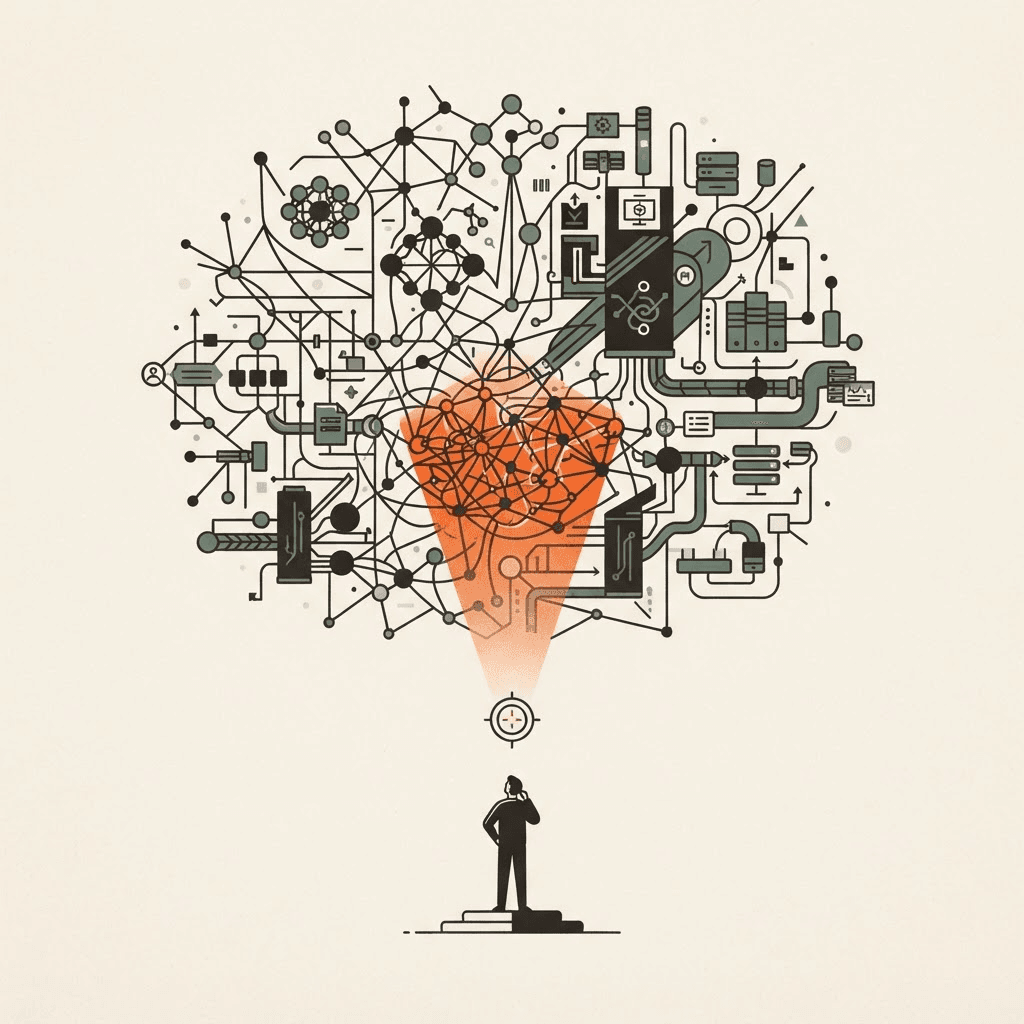
Production systems are not failing because they lack data. They are failing because we can no longer understand them fast enough. But when something breaks, teams still spend hours reconstructing what should have been obvious. Not because the signal isn't there. Because understanding cannot keep up with the speed and complexity of modern systems.
Every enterprise production environment already contains the answers to its own operational questions. Why did the checkout flow start timing out after Friday's deployment? What changed between the healthy state at noon and the cascade of alerts at 3:00am? Is the CPU spike on your payment service the root cause, or just collateral damage from something three hops upstream?
The data is there: enormous volumes of metrics, events, logs, and traces streaming through your observability stack every day. In fact, according to the 2026 State of Production Reliability and AI Adoption Report, 83% of organizations surveyed report their teams are ignoring alerts.
And that gap is exactly where incidents live.
Production today spans containers, virtual machines, cloud services, networking layers, and storage systems, all changing continuously. A single issue rarely stays isolated. It propagates across layers, surfaces as symptoms somewhere else, and leaves engineers chasing fragments of the truth across multiple tools. By the time the system is understood, the outage has already spread.
The first wave of "AI for observability" wrapped chat interfaces around existing APIs, creating dashboard copilots that query sequentially through rate-limited endpoints and often fail at cross-service reasoning. The second wave went further, proposing that telemetry must be pre-indexed into structured representations before AI can be effective.
That second wave gets closer to the truth. But it's still the wrong answer to the right question.
AI doesn't need a data model. It needs a context platform that combines telemetry, operational expertise, and real-time reasoning. That's what we built, and what powers the system we're launching today.
Introducing the NeuBird AI Production Operations Agent
Today we're launching the NeuBird AI Production Operations Agent, a fundamental expansion of what AI can do in production environments. Powered by our Agent Context Platform™, it prevents issues before they impact services, resolves incidents in minutes when they do occur, and continuously optimizes operations across cloud, on-premises, and hybrid environments.
This isn't an incremental update. It's a shift from reactive AI to autonomous production intelligence.
With today's launch, NeuBird AI delivers a new set of capabilities for enterprise teams, including:
- Preventive Ops Insights to surface risks before alerts fire,
- Advanced Context Map for real-time visibility into infrastructure dependencies and health,
- NeuBird AI Desktop for command-line access to the agent,
- NeuBird AI FalconClaw (tech preview), our enterprise-grade production operations skills hub.
With these innovations, NeuBird AI Production Operations Agent can be set up within 5 minutes in your environment, can deliver key operational insights within 5 minutes of setup with our Advanced Context Map, and can resolve any incident within 5 minutes. That's a NeuBird AI guarantee.
We also announced $19.3 million in a new oversubscribed funding round led by Temasek-backed Xora Innovation, with continued backing from Mayfield Fund, Microsoft M12 Ventures, alongside Prosperity7, bringing our total capital raised to $63.8 million.
The Production Operations Agent is made possible by the architectural foundation that makes accurate, autonomous results possible even in the largest, most complex production environment.
The Problem: Data Models Describe. Context Platforms Reason.
Every serious AI platform in production ops has arrived at the same starting point: raw telemetry isn't enough. You need a structured representation of your environment that AI can reason over. So far, so good.
Where approaches diverge is in what that structure looks like. The easy but error-prone approach taken by many companies today is to pre-index your telemetry into a static representation: compress it, layer on entities and baselines, mine dependency relationships, and let AI reason over that snapshot instead of the live environment.
It's a step forward from raw API queries. But it has three fundamental limitations.
First, a data model captures what exists. A context model captures what matters for this question, right now. Large production environments generate massive volumes of telemetry daily. Pre-indexing all of it means you're either storing everything or making choices about what to keep, and for how long. Those choices were made before you knew what question you'd need to answer. The incident that exposes the gap is always the one you didn't plan for.
Second, static models decay. No matter how frequently you rebuild, there's always a delta between the model and reality. The service deployed twenty minutes ago, the dependency that shifted since the last index cycle, the configuration change that hasn't been captured yet. These are precisely the events that cause incidents, and precisely the events that a pre-built model is most likely to miss. The claim that a model or database "maintains itself" is aspirational. The reality is that every index cycle introduces a window where the model and production are out of sync.
Third, and most critically, models without tools can describe but can't act. Knowing the topology of your environment is necessary but not sufficient. AI needs the ability to query live telemetry, execute diagnostic procedures, invoke remediation actions, access runbooks, and reason with domain-specific skills, all within a secure sandbox. A data model gives you a map. A context platform gives you the map, the car, the GPS, and the driving skills.
This is why we built the NeuBird AI Agent Context Platform.
The Agent Context Platform™: The Intelligence Layer Behind The Production Operations Agent
The NeuBird AI Agent Context Platform is the foundational technology that enables everything the NeuBird AI Production Operations Agent does. It's not a data model. It's a context model.
The distinction is architectural and it matters. A data model indexes what your environment looks like. A context model provides everything an AI agent needs to understand and operate within that environment: the objects, the functions, the skills, the tribal knowledge, the reasoning patterns, and the live telemetry, all assembled dynamically at query time rather than pre-indexed into a static replica.
The Agent Context Platform comprises four layers that work together.
The Object Model represents every entity in your production environment (services, dependencies, infrastructure components, configurations, alert rules, deployment pipelines) as queryable, relatable objects. Unlike a static topology map or a CMDB that was last updated six months ago, this representation is continuously derived from live telemetry and code. When a new service is deployed or a dependency shifts, the object model reflects it in the next query, not the next index cycle. Dependencies are confidence-weighted, mined from actual production behavior rather than documented assumptions.
Tools are the verbs of production ops: the diagnostic procedures, analytical operations, health checks, and remediation actions that an expert SRE would execute during an investigation. The Agent Context Platform exposes them as first-class capabilities that AI can invoke safely and programmatically. This is what separates a system that can describe a problem from one that can investigate and fix it. Tools run in a sandboxed code execution environment: no internet access, no file system access, read-only where safety demands it.
Skills encode domain-specific expertise: how to investigate a Kubernetes OOM kill versus a Databricks job failure versus an Azure networking issue versus a mainframe batch processing anomaly. Each skill packages the reasoning patterns, query strategies, escalation logic, and resolution playbooks for a specific problem domain. Skills are what allow The Production Operations Agent to reason like a specialist, not a generalist. They're what led us to build FalconClaw, which draws from ClawHub (the skills hub for OpenClaw, the most popular open source project in history) and puts every skill through a rigorous security review before it reaches your production environment.
Enterprise Knowledge is the layer that turns every investigation into institutional learning. Past RCAs, runbooks, debugging heuristics, team conventions, and the accumulated wisdom from every prior investigation are captured as a living knowledge graph, akin to your organizational tribal knowledge, only all of it is always accessible and available. Not static documents that decay, but a continuously enriched structure with cross-user learning. Coach the agent once on how your team handles a specific failure mode; it remembers permanently and applies that knowledge across every future incident. This is the context that no external AI can provide and no pre-built model can capture. It's yours, and it gets better every day.
The critical point: these four layers are not independent databases. They're an integrated context model that the Agent Context Platform assembles dynamically for every investigation. When a P1 fires at 3 AM, the engine doesn't query a static index. It pulls the relevant objects, selects the right functions and skills, retrieves applicable tribal knowledge, and constructs precisely the context needed for this specific problem in real time. That's context engineering, and it's fundamentally different from telemetry data indexing.
The Agent Context Engine™: Reasoning, Not Retrieval
If the Agent Context Platform is the foundation, the Agent Context Engine™ (ACE) is the reasoning core that drives it. ACE is NeuBird AI's breakthrough technology for surgically accurate AI reasoning over production environments, and the engine behind every investigation, every prediction, and every optimization The Production Operations Agent performs.
The critical distinction: ACE doesn't retrieve answers from a pre-built index. It reasons over dynamically assembled context to construct answers that are causally consistent with how your system actually behaves.
Dynamic context assembly. When ACE investigates an incident, it assembles precisely the right context at query time, pulling from live telemetry, traversing real-time dependency graphs, correlating change history, and drawing on tribal knowledge simultaneously. ACE is never stale. It's reasoning over ground truth, not a snapshot.
Chain-of-thought causal reasoning. ACE traces causal chains across services, teams, and time, with explicit reasoning at every step. Not "these metrics spiked at the same time" (correlation), but "this deployment changed this configuration, which affected this dependency, which caused this cascade" (causation). When The Production Operations Agent tells you the root cause, it shows you why: a complete chain of evidence, not a probable guess.
Programmatic analysis in a secure sandbox. ACE doesn't just query. It investigates like your best engineer would. A secure, isolated code execution environment lets the engine write and run analytical code against live telemetry. No internet access, no file system access, no external calls. Safe, deterministic, and enormously powerful.
Agent personas and skill selection. ACE automatically selects the right reasoning strategy and domain skills for each problem type. A container scaling issue gets a different investigative approach than a database connection pool exhaustion or a network partition. Domain expertise is codified and selected dynamically, not improvised at inference time.
Today's launch includes our new Falcon engine, the next-generation engine that dramatically extends ACE's capabilities, particularly for predictive intelligence. Falcon powers the new Preventive Ops Insights, which continuously analyze telemetry patterns to surface recurring risks, deployment triggers, and systemic weaknesses before they escalate. It also drives the Advanced Context Map, a real-time view of infrastructure dependencies, service health, and blast radius that lets teams understand how failures propagate across environments.
The result: 94% RCA accuracy, investigations that complete in minutes instead of hours, and, for the first time, the ability to prevent incidents before they fire.
Works Wherever Engineering Happens
The Production Operations Agent's intelligence isn't useful if it only surfaces in one place. Production teams work in Slack at 3 AM, in terminals during an active incident, in IDEs when a deployment is going wrong. The value of an autonomous reasoning system depends entirely on whether it shows up where the work actually happens.
With today's launch, that means NeuBird AI's web console, NeuBird AI Desktop for command-line access, and native Slack and Teams integrations, all powered by the same reasoning engine, the same context model, and the same institutional memory. No capability gap between interfaces. No need to log in somewhere else to get the full picture.
NeuBird AI Desktop lets engineers invoke the full power of the platform directly from a terminal: explore root cause, trace dependencies, and assess operational impact without context-switching. Teams can chain NeuBird AI's insights with coding agents like Cursor, automate runbook updates, and connect remediation actions directly into change workflows.
Beyond NeuBird AI's own products, the platform is designed to be consumed as a context engine service, not just used as a product. Any MCP-compatible AI agent, IDE, or custom-built workflow can connect to the same reasoning engine. As agentic AI matures, this means NeuBird AI's production intelligence becomes a shared capability across an organization's entire AI stack, not a siloed tool.
Same context. Same reasoning. Same institutional memory. Different interaction patterns.
Announcing FalconClaw, the NeuBird AI Skills Hub: Turning Tribal Knowledge into a Competitive Advantage
Here's a truth about production operations that no amount of technology can fully address on its own: every organization's environment is unique. The failure modes, the debugging heuristics, the "we tried that last time and here's what actually worked" knowledge. It's specific to your stack, your architecture, your team's hard-won experience.
This is why we built the NeuBird AI FalconClaw.
Think of it this way: the Agent Context Platform provides the general intelligence layer. FalconClaw is where your organization's specific intelligence lives.
FalconClaw is a curated, enterprise-grade production operations skills hub, fully compatible with the OpenClaw ecosystem. It lets teams capture and operationalize their tribal knowledge and best practices as reusable, validated, and compliant skills that the NeuBird AI agent uses automatically. It is available as a tech preview with 15 production-ready skills that work natively with NeuBird AI's toolchain.
Operations teams have deep tribal knowledge about how their systems fail and how to fix them. FalconClaw lets them encode that knowledge into skills that NeuBird AI uses automatically. It turns every team's hard-won expertise into a reusable, shareable asset. — Francois Martel, Field CTO, NeuBird AI
What This Enables: Prevent, Resolve, Optimize
The Agent Context Platform and FalconClaw together enable the full surface of production operations, not just the reactive slice that most AI SRE platforms address.
Prevent. The Production Operations Agent detects degradation 30 to 60 minutes before failure, flags configuration drift before cascade, and runs proactive health checks on schedule. Falcon's Preventive Ops Insights continuously analyze telemetry patterns to surface recurring risks and deployment triggers. The numbers from our customers are stark: 78% alert noise reduction, with engineers reclaiming time previously lost to false positives and manual triage.
We're now starting to prevent issues before they impact production. — Navdip Bhachech, SVP Engineering at Bedrock Analytics
Resolve. When incidents do occur, ACE traces the full causal chain — triage, blast radius mapping, root cause analysis, and remediation — in minutes, not hours. FalconClaw skills automatically hand off RCAs to a coding agent to generate fixes and a DevOps agent to deploy the fix. Replace your eight-person war room with just one intelligent platform.
Optimize. The same context platform that prevents and resolves incidents reveals cloud waste, observability gaps, and automation opportunities. Right-sizing, unused resources, reserved instance opportunities. Direct, measurable dollar savings across the stack.
Enterprise-Grade by Design
The Production Operations Agent runs as a secure, SOC2 compliant SaaS deployment or entirely inside customer infrastructure: VPC-native, with support for fully air-gapped deployments. For regulated industries, this isn't a feature; it's a prerequisite. Many Fortune 500 companies cannot send production telemetry to a third-party cloud. We don't ask them to.
Integration is agentless. The platform connects to your existing observability stack (50+ integrations across Datadog, Dynatrace, NewRelic, Prometheus, CloudWatch, Splunk, ServiceNow, PagerDuty, and more) without new agents, sidecars, or pipelines. And because ACE assembles context dynamically rather than building a model over weeks, there's no extended onboarding period. Deploy and get value, not deploy and wait.
You Don't Resolve What You Don't Understand
The real bottleneck in production operations is not Mean Time to Repair. It is Mean Time to Understand.
Every minute spent reconstructing context during an outage is a minute of revenue lost, customer trust eroded, and engineering talent burned on work that should never have required a human. The most powerful language models in the world cannot compress that time if they're reasoning over incomplete telemetry without domain expertise, dependency awareness, or institutional memory.
The winner in production ops AI won't be determined by model benchmarks. It will be determined by who builds the best context layer between the LLM and the production environment.
That context layer is the Agent Context Platform with Agent Context Engine as the reasoning engine. This is the outcome of years of groundbreaking AI and Deep Context Engineering research, battle-tested at enterprise scale across the Fortune 100, and backed by over $63 million from Microsoft, Mayfield, Xora from Temasek, and Prosperity7 ventures.
NeuBird AI reduces Mean Time to Understand from hours to minutes. Faster resolution, fewer incidents, lower costs, and engineering teams that spend their time building, not firefighting. That's what The Production Operations Agent delivers. And with the Falcon update of the Agent Context Engine along with FalconClaw, it's available now.
NeuBird AI Falcon update is available today in the latest version of NeuBird AI. Get started at neubird.ai or request a demo. Download the 2026 State of Production Reliability and AI Adoption Report for the latest industry data on how engineering teams are navigating production complexity.